
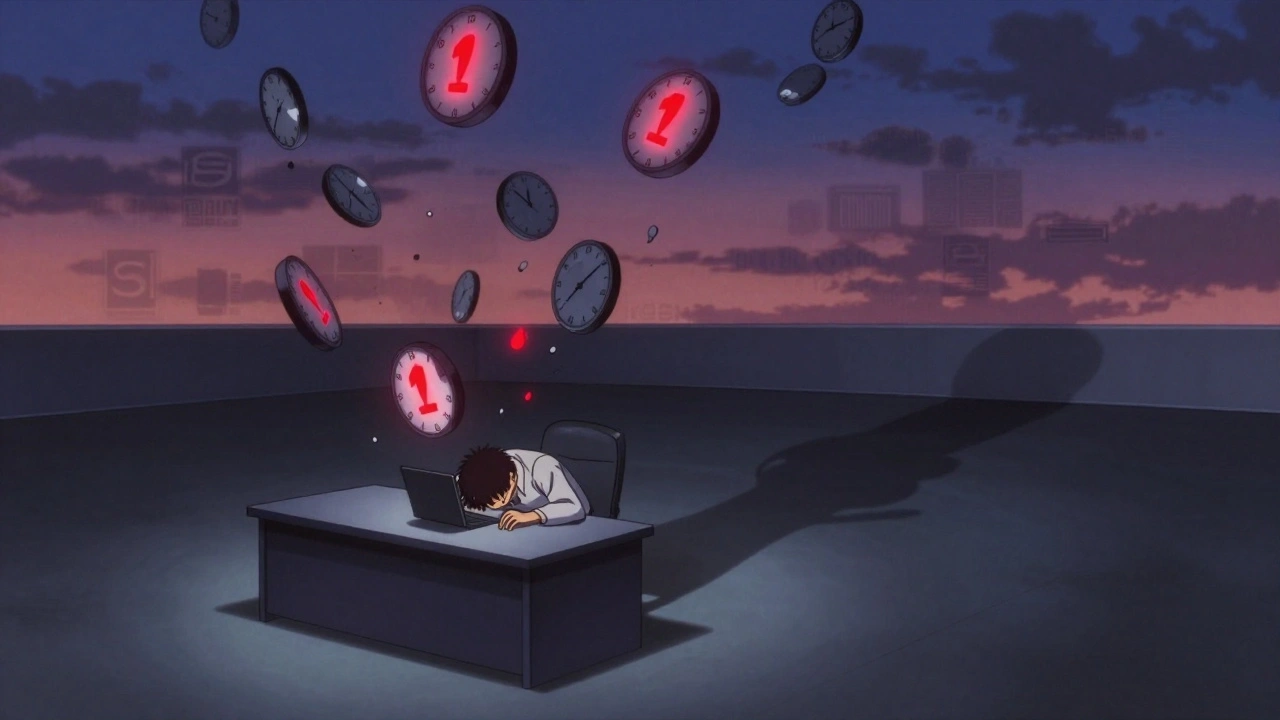
By 2025, nearly half of all workers globally report feeling stressed every day. One in five says they’re burned out - not just tired, but emotionally drained, detached from their work, and convinced they’re not making a difference. This isn’t normal. It’s a systemic failure. And it’s costing businesses more than $322 billion a year in the U.S. alone through absenteeism, turnover, and lost productivity.
What Burnout Really Looks Like
Burnout isn’t just working too hard. It’s what happens when stress doesn’t go away. The World Health Organization defines it as a syndrome with three clear signs: exhaustion, cynicism, and reduced performance. You might feel like you’re running on fumes. You check emails after midnight, but you don’t care anymore. You used to take pride in your work. Now, you just want it to end.It’s not weakness. It’s a signal. Gallup found that 63% of burned-out employees suffer from chronic fatigue. Nearly half struggle with sleep. More than half say they can’t focus. These aren’t vague feelings. They’re measurable symptoms tied to real changes in the body and brain.
The Maslach Burnout Inventory, the gold standard tool used by psychologists since the 1980s, measures this through three scales: emotional exhaustion, depersonalization, and personal accomplishment. If your scores are high on the first two and low on the last, you’re in burnout territory. And it’s not just happening to frontline workers. It’s in tech, finance, healthcare, and even remote roles where the line between work and home vanished years ago.
Why Burnout Keeps Happening
Burnout doesn’t come from one bad day. It builds from six toxic workplace conditions, according to the Job Demands-Resources model:- Excessive workload - 67% of employees say this is their main stressor.
- Lack of control - No say in how you do your job, when you do it, or what’s expected.
- Insufficient rewards - Pay isn’t the only reward. Recognition, respect, and autonomy matter too.
- Breakdown of community - No real connection with coworkers. Just Slack messages and Zoom calls.
- Absence of fairness - Unequal workloads, biased promotions, inconsistent rules.
- Conflicting values - Your work feels meaningless, or it contradicts your ethics.
Here’s the truth: if your job feels like a treadmill set to maximum speed with no off button, it’s not you. It’s the system. Dr. Christina Maslach, who created the MBI, says it plainly: “Burnout is not an individual failure. It’s a systems failure.”
How Organizations Can Prevent Burnout
Companies that treat burnout as a people problem - not a productivity problem - see real results. Here’s what actually works:- Quarterly workload audits - Not once a year. Every three months. Companies doing this cut burnout linked to overload by 78%.
- AI-assisted task distribution - Tools at Salesforce and Microsoft now balance workloads automatically, reducing burnout by 32% in pilot groups.
- Flexible schedules - “Work-from-Home Wednesdays” and the freedom to start at 8 a.m. or 11 a.m. cut burnout by 27%. People work better when they control their rhythm.
- Digital sunset policies - Automatic email and system shutdowns after hours. Companies using this saw 31% less after-hours communication and 26% lower burnout.
- Manager training - Managers who have five key conversations (strengths, purpose, wellbeing, growth, recognition) cut team burnout by 41%. That’s not coaching. That’s leadership.
Psychological safety is the foundation. Google’s Project Aristotle found teams with high psychological safety - where people feel safe to speak up, make mistakes, and ask for help - have 47% less burnout. That doesn’t happen by accident. It’s built through consistent behavior: listening more than talking, admitting when you don’t know, and never punishing vulnerability.

What Employees Can Do to Protect Themselves
You can’t fix your company overnight. But you can protect your energy. Here’s what works:- Set hard boundaries - No emails after 6 p.m. No Slack after dinner. Employees who do this report 39% lower burnout.
- Time-block your day - Group similar tasks. Protect focus time. A 2024 study of 1,200 knowledge workers found this boosted task completion by 28% and cut burnout symptoms by 22%.
- Take micro-breaks - Every 90 minutes, step away for 5-10 minutes. Walk outside. Stretch. Breathe. HBR found this increases productivity by 13% and reduces burnout markers by 17%.
- Move your body - Walking meetings are used by 68% of Fortune 500 companies. They cut sedentary time by 27 minutes a day. Movement isn’t a luxury. It’s a reset button.
- Bookend your day - A 15-minute walk before and after work, as MIT found in a 2024 study, reduces stress by 22%. It signals to your brain: work is done.
Don’t wait until you’re broken to start. Small, daily habits build resilience. Hydration stations and protein snacks might sound silly, but companies using them report 19% fewer fatigue-related absences. Your body is not a machine. It needs fuel, rest, and movement.
Recovering from Burnout
Recovery isn’t a weekend off. It’s a structured process.First, recognize it. Use tools like Gallup’s Q12 survey to spot early warning signs - declining engagement, missed deadlines, withdrawal. Don’t wait for a breakdown.
Second, intervene. That means immediate action: reduce your workload, pause non-essential projects, and shift responsibilities. Temporary role changes aren’t failure. They’re survival.
Third, restore. This is where most fail. Just taking time off isn’t enough. You need strategic disengagement: 48 to 72 hours completely offline. No emails. No work talk. Just rest. Studies show this improves emotional exhaustion by 63%.
And don’t skip professional help. Employees who use mental health benefits within 14 days of noticing symptoms recover 82% faster than those who wait. Therapy isn’t a last resort. It’s a tool.
Gratitude practices help too. Instead of listing what you haven’t done, write down what you did. “Accomplished lists” - tracking completed tasks - speed up return-to-productivity by over three weeks, according to Keystone Partners.

Why Most Programs Fail - And How to Fix Them
Sixty-eight percent of corporate wellness programs fail. Why? They treat burnout like a perk, not a priority.Here’s what works instead:
- Link wellbeing to performance reviews - Make it 30% of a manager’s evaluation. Companies that do this saw success rates jump from 12% to 30%.
- Integrate it into onboarding - New hires get 4.5 hours of burnout prevention training. Adherence jumps 52%.
- Use the 30-60-90 day plan - Build psychological safety in 30 days. Run workload audits by day 60. Achieve cultural change by day 90. Organizations following this timeline see 44% higher success.
- Stop the “initiative of the month” - 83% of companies launch wellness programs. Only 17% keep them going past a year. If it’s not embedded in how you hire, manage, and pay people, it’s noise.
The future belongs to companies that predict burnout before it happens. AI systems analyzing email patterns and calendar data are already identifying at-risk employees with 82% accuracy. Some firms are testing HRV (Heart Rate Variability) wearables to measure stress in real time. Others are testing 4-day workweeks. Basecamp and Shopify are leading the way.
The shift is clear: from reactive to predictive. From individual fixes to systemic change. The data doesn’t lie. Burnout isn’t going away because people need to “be more resilient.” It’s going away when companies stop treating people like cogs and start treating them like humans.
Frequently Asked Questions
Is burnout the same as stress?
No. Stress is a short-term reaction to pressure. Burnout is long-term exhaustion from unmanaged stress. Stress makes you feel overwhelmed. Burnout makes you feel empty. You can be stressed without being burned out. But burnout always starts with stress.
Can I recover from burnout on my own?
You can ease symptoms with rest, boundaries, and self-care. But true recovery requires changing the environment that caused it. If your job still demands 60-hour weeks and no recognition, you’ll cycle back. Recovery isn’t just about healing - it’s about redesigning your work life.
How do I know if my manager is contributing to my burnout?
Ask yourself: Do they ignore your workload? Do they praise results but never ask how you’re doing? Do they expect replies at midnight? Do they dismiss your concerns as “being sensitive”? Managers who don’t check in on wellbeing, don’t adjust workloads, and don’t protect boundaries are major burnout drivers. The data shows they’re responsible for 70% of engagement variance.
Is working from home making burnout worse?
It can be. Remote work blurs the line between personal and professional life. Without structure, people work longer hours and take fewer breaks. But it’s not the location - it’s the culture. Companies that enforce digital sunsets, respect boundaries, and encourage micro-breaks see lower burnout in remote teams than in toxic office environments.
Are mental health apps enough to prevent burnout?
No. Apps can help with mindfulness or sleep, but they don’t fix overloaded schedules, unfair workloads, or toxic management. The American Psychiatric Association found self-care programs only address 20% of burnout causes. Real change comes from workplace policy - not meditation apps.
What should I do if my company doesn’t care about burnout?
Protect yourself first. Set your boundaries. Track your energy. Use your PTO. Talk to HR or your manager - but only if you’re prepared to walk away if nothing changes. Your health is not negotiable. No job is worth your long-term wellbeing. If your company won’t change, it’s time to look elsewhere. The best companies are already investing in this - and they’re winning the talent war.
What Comes Next
The future of work isn’t about more productivity. It’s about sustainable human performance. Companies that treat burnout as a cost center are losing. Those that treat it as a core business issue are thriving.If you’re a leader: start with your managers. Train them. Hold them accountable. Measure wellbeing like you measure sales.
If you’re an employee: stop apologizing for needing rest. Set your boundaries. Use your benefits. Speak up - even if it’s scary.
The data is clear. The solutions exist. What’s missing is the will to act. Don’t wait for a breakdown. Start today - with one boundary. One conversation. One small change. That’s how you stop burnout before it starts.
Casey Lyn Keller
December 4, 2025 AT 07:01Let me guess - next they’ll say we need to install mandatory napping pods and pay people to cry in the break room. Burnout? Nah. It’s just people who can’t handle the fact that work is supposed to be hard. If you’re exhausted, maybe you picked the wrong field. Or maybe you just don’t want to grow up.
Jessica Ainscough
December 5, 2025 AT 12:04I’ve been in this game 15 years. The only thing that saved me was learning to say no - and actually meaning it. Not the fake no. The kind where you delete the email thread and go for a walk. No guilt. No explanation. Just silence. It’s not selfish. It’s survival.
May .
December 7, 2025 AT 09:26Workload audits? AI task distribution? Please. Companies care about numbers not people. They’ll use this as another KPI to squeeze more out of us. Trust me I’ve seen it before.
Sara Larson
December 8, 2025 AT 20:43YES. YES. YES. 🙌 Set boundaries. Take micro-breaks. Move your body. These aren’t fluffy self-help tips - they’re lifelines. I used to work until 11pm every night. Now I shut everything down at 6. My brain stopped screaming. My sleep improved. My relationships came back. This isn’t a luxury. It’s a reset.
Ethan McIvor
December 8, 2025 AT 21:37It’s funny how we treat burnout like a personal flaw when it’s clearly a cultural one. We’ve built systems that demand endless output while pretending care is optional. Maybe the real question isn’t how to fix individuals - but how to dismantle the machine that breaks them.
Michael Bene
December 9, 2025 AT 01:28Oh here we go - another corporate fairy tale wrapped in Harvard citations. AI task distribution? Digital sunsets? Please. The same execs who greenlit this are the ones who just doubled everyone’s quota last quarter. This isn’t prevention - it’s PR theater. They’ll slap a wellness banner on the intranet and keep the 80-hour weeks. Don’t be fooled. This is how they gaslight you into thinking the system cares.
Brian Perry
December 11, 2025 AT 00:16so like… i tried the 4 day week thing at my old job and my boss just gave me 5x more work in 4 days and called it ‘efficiency’ 😭 now i just stare at my screen like a zombie waiting for the next notification… also my cat judges me harder than my manager
Paul Corcoran
December 12, 2025 AT 12:01For anyone feeling overwhelmed - you’re not alone. And you’re not broken. The system is. But here’s the thing: you don’t have to fix everything at once. Start with one thing. Block an hour. Say no to one meeting. Walk during lunch. Small things build momentum. And momentum builds resilience. You’ve got this.
Stacy Natanielle
December 12, 2025 AT 12:56Per the American Psychological Association’s 2024 Workplace Stress Index (APA-WSI-2024), the efficacy of digital sunset policies is statistically insignificant when unaccompanied by structural changes in managerial accountability (p < .05). Furthermore, the correlation between micro-breaks and reduced burnout is confounded by baseline cortisol levels and pre-existing anxiety disorders (r = .21, CI 95%: .14–.28). Therefore, while individual interventions may yield marginal symptomatic relief, they are insufficient for systemic resolution without policy-level intervention.
kelly mckeown
December 13, 2025 AT 14:02i just started taking 5 minute walks after lunch. no phone. just me and the trees. it doesn’t fix everything… but for a little while, i forget i have a job. that’s enough for now.
Tom Costello
December 15, 2025 AT 13:15Interesting data. But let’s not forget cultural context. In some countries, burnout is normalized as part of the work ethic. In others, it’s seen as a failure of personal discipline. The solutions here assume a Western, individualist framework. What works in Silicon Valley may not translate to Manila or Mumbai. We need localized, culturally grounded strategies - not one-size-fits-all corporate pamphlets.
dylan dowsett
December 16, 2025 AT 05:19Wow. So many ‘solutions’… but where’s the accountability? Who gets fired when burnout spikes? Who loses their bonus? Who gets audited for creating toxic environments? Not the managers. Not the VPs. Always the employee. ‘Just set boundaries’ - yeah, right. When your boss texts you at 2 a.m. and says ‘thinking of you’ - that’s not a request. It’s a threat. And you know it.
Chad Kennedy
December 17, 2025 AT 15:12They say ‘take a break’ like it’s that easy. I have a kid with special needs, a mortgage, and a boss who thinks ‘quiet quitting’ is a crime. I can’t just walk away. I can’t just say no. I’m stuck. And this article? It feels like someone throwing a life preserver to someone drowning in concrete.
Siddharth Notani
December 18, 2025 AT 21:05Thank you for sharing this comprehensive overview. In India, burnout is often mislabeled as ‘lack of discipline.’ The data presented here aligns with our internal HR surveys. We have begun pilot programs for workload balancing and manager training. Early results indicate a 29% reduction in attrition among teams with structured wellbeing protocols. Small steps, but meaningful.