
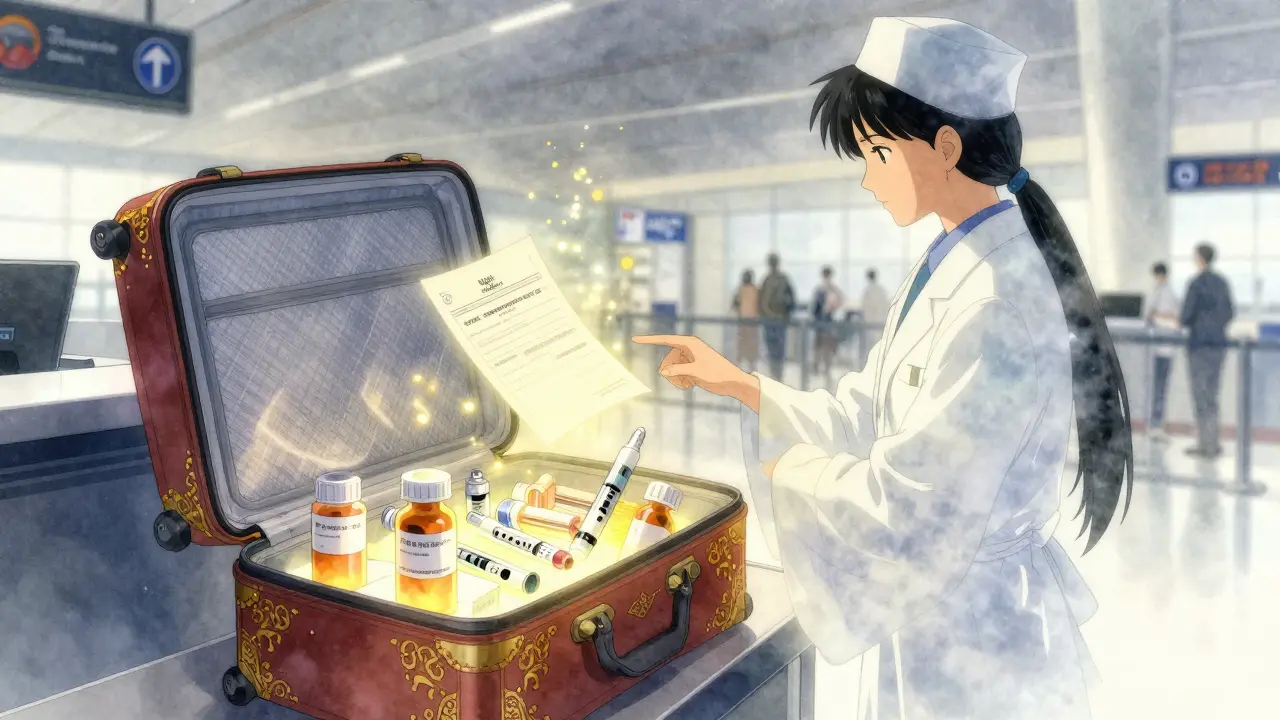
When you're packing for a trip, you think about clothes, chargers, and maybe a good book. But if you take medication every day, there’s one thing you can’t afford to forget: your pills. And not just the pills themselves-how you carry them, where you store them, and whether they’re even legal where you're going. A missed dose, a melted insulin pen, or a customs officer questioning your prescription can turn a dream vacation into a nightmare. The good news? With a little planning, you can avoid all of it.
Keep Your Medications in Original Containers
Never transfer your pills into pill organizers or random containers before you travel. The TSA, U.S. Customs, and foreign border agents all require medications to be in their original pharmacy-labeled bottles. That means the bottle with your name, the drug name, the prescriber’s name, and the pharmacy’s stamp. It’s not just a suggestion-it’s a rule. In 2022, the U.S. Department of State documented over 1,200 cases where travelers were detained or denied entry because their meds weren’t properly labeled. One high-profile case involved a Toyota executive detained in Japan for 23 days after customs found a painkiller she’d mailed to herself. The medication was legal in the U.S., but banned in Japan. She didn’t know. You don’t have to make the same mistake.
Bring More Than You Think You’ll Need
Flights get delayed. Luggage gets lost. You catch a bug. That’s why experts at Northwestern University and IDDP Pharmacy both recommend bringing a 7- to 14-day extra supply. If you’re on a two-week trip, pack enough for four weeks. This isn’t about being paranoid-it’s about being prepared. Insulin, heart meds, seizure drugs, antidepressants: if you run out, you can’t just walk into a pharmacy abroad and refill your U.S. prescription. Overseas pharmacies don’t accept them. And no, you can’t have your meds shipped to you while you’re away. The CDC confirms this: once you leave the U.S., your prescription is dead in the water. Plan ahead. Call your pharmacy at least two weeks before you leave. Most insurance plans allow early refills-usually up to five days before your usual refill date. Ask them to give you enough to cover your trip plus the extra buffer.
Know the Rules for Liquids and Airport Security
You’ve heard the 3.4-ounce rule for liquids. But here’s the exception: medications are exempt. The TSA allows liquid medications-even large bottles of insulin or liquid antibiotics-as long as you declare them at the security checkpoint. Put them in a separate clear plastic bag, not with your shampoo and toothpaste. You don’t need to limit the amount. You do need to tell the officer. Some travelers get nervous and try to hide their meds. Don’t. TSA agents see this every day. They’re trained to handle it. Just say, “I have medication,” and hand them your bottle. If you’re carrying syringes or injectables, bring a doctor’s note. It’s not always required, but it saves time and stress.
Temperature Matters More Than You Think
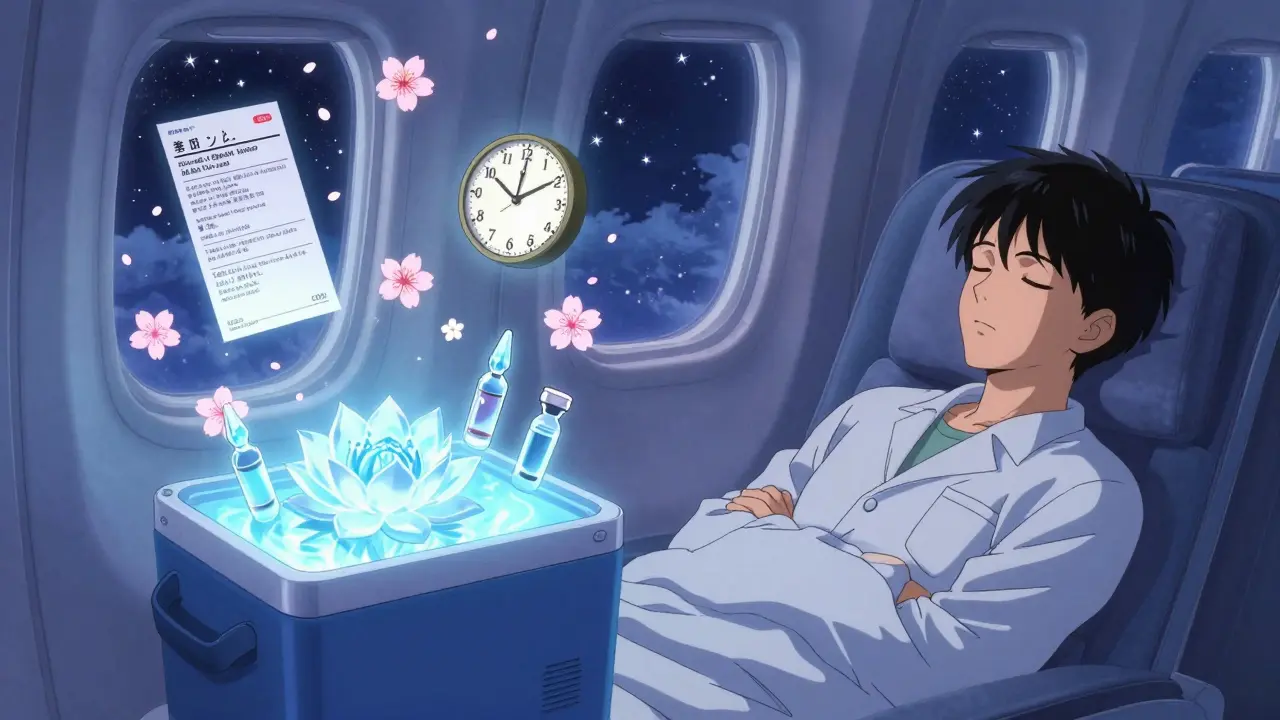
Not all pills are created equal when it comes to heat. Insulin, certain antibiotics, and some biologics need to stay cool. Between 36°F and 46°F (2°C-8°C) is the sweet spot. Leave them in your checked bag? Bad idea. The cargo hold can hit 120°F on a hot day. That’s why you carry them in your carry-on. If you’re flying to a tropical destination or heading out for a summer road trip, consider a small, insulated cooler pack designed for meds. These can keep insulin cold for 48+ hours. For most other pills-pills you swallow, not inject-keeping them below 86°F (30°C) is enough. Avoid leaving them in a hot car. Sunlight through a window can raise the temperature inside a pill bottle way beyond what’s safe.
Check Your Meds Are Legal Where You’re Going
This is the step most people skip. And it’s the one that gets people arrested. The U.S. State Department reports that 67% of countries restrict at least one common U.S. medication. Adderall? Banned in Japan, Singapore, and 14 other countries. Ambien? Illegal in Germany and South Korea. Sudafed? Restricted in 28 countries because it contains pseudoephedrine. Even common painkillers like codeine are controlled in places like the UK, Australia, and Canada. The good news? You don’t have to guess. The U.S. State Department launched an interactive Medication Check Tool in March 2023. Go to the website of the U.S. embassy in your destination country. Search for your medication by name. If it’s restricted, they’ll say so. If you’re unsure, email the embassy directly. Some even offer pre-travel consultation emails. Don’t wait until you’re at customs to find out your meds aren’t allowed.
Adjust for Time Zones Without Risk
Jet lag doesn’t just mess with your sleep-it messes with your schedule. If you take a pill every day at 8 a.m., what do you do when you land in Tokyo and it’s 11 p.m. back home? The rule of thumb: it’s usually safe to take your medication one or two hours early or late. But never double up. Never skip. If you’re on a 12-hour time difference, plan your schedule a day ahead. Set two alarms on your phone: one for home time, one for local time. Use apps like Medisafe or MyTherapy-they’ll remind you in both time zones. If you’re on a complex regimen (like multiple pills at different times), talk to your pharmacist before you leave. They can help you map out a new schedule that keeps you safe.
Carry Documentation-Even If You Think You Don’t Need It
A copy of your prescription isn’t enough. Bring a letter from your doctor. It should say your name, your condition, the medications you’re taking, and why you need them. This is especially critical if you’re carrying controlled substances, injectables, or psychiatric meds. Some airlines, like Emirates, require advance approval for any medication containing codeine or stimulants. Having a doctor’s note speeds things up. And if you’re traveling internationally, consider laminating a copy of your prescription in both English and the language of your destination. Travelers who do this report 93% fewer issues at customs. A simple phrase like “This is my insulin for diabetes” in Japanese or French can make all the difference.
What to Do If You Lose Your Medication
Even if you do everything right, things can go wrong. If your bag gets lost and you’re left without meds, here’s what to do: First, stay calm. Second, contact your airline’s baggage service immediately. Third, call your doctor or pharmacy back home. They can fax or email a prescription to a local pharmacy in your destination. Fourth, reach out to the nearest U.S. embassy or consulate. They can help you find a local doctor or pharmacy that can assist. Many embassies keep a list of trusted local providers. Don’t try to buy meds on the street or from an unlicensed vendor. You could end up with fake, expired, or dangerous drugs.
Real Stories, Real Lessons
One traveler on Reddit shared how she was denied entry into South Korea because her ADHD medication wasn’t approved there-even though she had a doctor’s note and the original bottle. She spent 12 hours in customs before being sent home. Another man in Thailand had his insulin spoil after leaving it in a hotel room with no AC. He ended up in the ER. But there are good stories too. A woman who carried her insulin in a medical-grade cooler pack made it through 14 countries without a single issue. She set phone alarms for every dose and carried her doctor’s letter in both English and Spanish. She didn’t just survive her trip-she thrived.
Final Checklist Before You Leave
- ✅ Confirm you have 7-14 extra days’ worth of all medications
- ✅ Keep all meds in original pharmacy bottles with labels
- ✅ Carry liquids in a separate clear bag and declare them at security
- ✅ Store temperature-sensitive meds in your carry-on
- ✅ Check each destination country’s medication laws using the U.S. State Department tool
- ✅ Get a doctor’s letter for controlled or injectable meds
- ✅ Set dual-time alarms on your phone for dosing
- ✅ Carry laminated copies of prescriptions in English and local language
- ✅ Never pack meds in checked luggage
Traveling with medication isn’t about fear. It’s about control. You’ve managed your health for years. Now, you’re just taking that same care with you. The world is full of places worth seeing. Don’t let a forgotten pill or a misunderstood rule keep you from seeing them.
Can I bring my medication in a pill organizer while traveling?
No. Always keep medications in their original pharmacy-labeled containers. Pill organizers are fine for daily use at home, but TSA and international customs require the original packaging with your name, drug name, and prescription info. If you want to use a pill organizer for convenience, pack the original bottles separately and carry them with you at all times.
What if my medication is banned in the country I’m visiting?
If your medication is banned, you cannot bring it. There are no exceptions. Even with a prescription, you risk detention, deportation, or criminal charges. Talk to your doctor before you travel. They may be able to prescribe an alternative that’s legal in your destination. For example, if Adderall is banned in Japan, your doctor might switch you to a non-stimulant like Strattera. Never assume your U.S. prescription will be accepted abroad.
Do I need to declare my medications at U.S. airport security?
You don’t need to declare regular pills, but you must declare liquid medications over 3.4 ounces. Place them in a separate clear plastic bag and tell the TSA officer you have medication. They’ll screen it separately. Even if you’re carrying only pills, it’s a good idea to mention them if asked. Being upfront prevents delays and misunderstandings.
Can I refill my prescription overseas?
No. Overseas pharmacies cannot refill U.S. prescriptions. Even if you find a pharmacy that seems willing, the medication may not be the same brand or dosage. In some countries, the drug may not even be approved. Always bring enough for your entire trip plus a 7-14 day buffer. If you’re staying longer than planned, contact your doctor back home-they may be able to send a new prescription electronically to a pharmacy in your destination, if allowed.
What should I do if I have an allergic reaction or side effect while traveling?
If you experience a severe side effect-like trouble breathing, swelling, chest pain, or confusion-seek medical help immediately. Call local emergency services or go to the nearest hospital. Carry a list of your medications and allergies in both English and the local language. Many travel clinics and embassies provide these in printed form. Don’t wait to see if it passes. Severe reactions can escalate quickly, especially in unfamiliar healthcare systems.
If you're planning a trip and take regular medication, start preparing at least three weeks ahead. Talk to your doctor. Call your pharmacy. Check the U.S. State Department’s Medication Check Tool. You’ve done the hard work managing your health. Now, make sure your travel plans don’t undo it.
Joy Johnston
February 5, 2026 AT 04:45Katherine Urbahn
February 7, 2026 AT 03:09Shelby Price
February 7, 2026 AT 11:18pradnya paramita
February 7, 2026 AT 17:35Keith Harris
February 8, 2026 AT 15:27Jesse Naidoo
February 9, 2026 AT 14:37Geri Rogers
February 10, 2026 AT 03:14Harriot Rockey
February 10, 2026 AT 08:13Jamillah Rodriguez
February 10, 2026 AT 13:28