
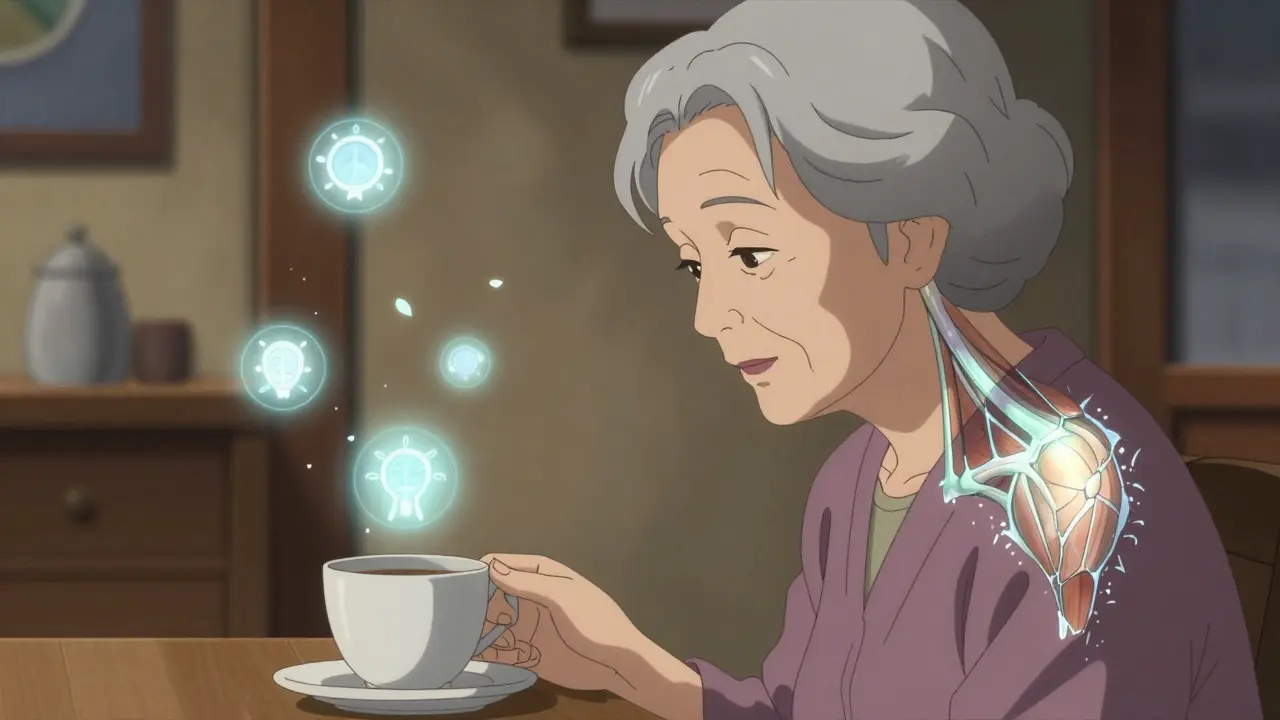
When your shoulder starts hurting with simple movements-reaching for a coffee cup, combing your hair, or lifting a grocery bag-it’s easy to write it off as just aging. But if the pain lingers, wakes you up at night, or makes your arm feel weak, you might be dealing with a rotator cuff tear. This isn’t just a minor strain. It’s a tear in one or more of the four tendons that hold your shoulder joint steady. And while it’s common, especially after 40, it’s not something you should ignore.
What Exactly Is a Rotator Cuff Tear?
The rotator cuff is made up of four muscles and their tendons: supraspinatus, infraspinatus, teres minor, and subscapularis. These tendons attach the shoulder blade to the upper arm bone and keep the ball of the joint snug in its socket. A tear happens when one of these tendons pulls away from the bone-either from a sudden injury like a fall or from gradual wear and tear over time.
Here’s the surprising part: about 54% of people over 60 have a rotator cuff tear-without even knowing it. Studies show they feel no pain and move just fine. That’s because not all tears cause symptoms. But when they do, the pain is usually deep in the shoulder, worse at night, and gets stronger when you lift your arm sideways or reach behind your back.
How Doctors Diagnose It: Imaging Explained
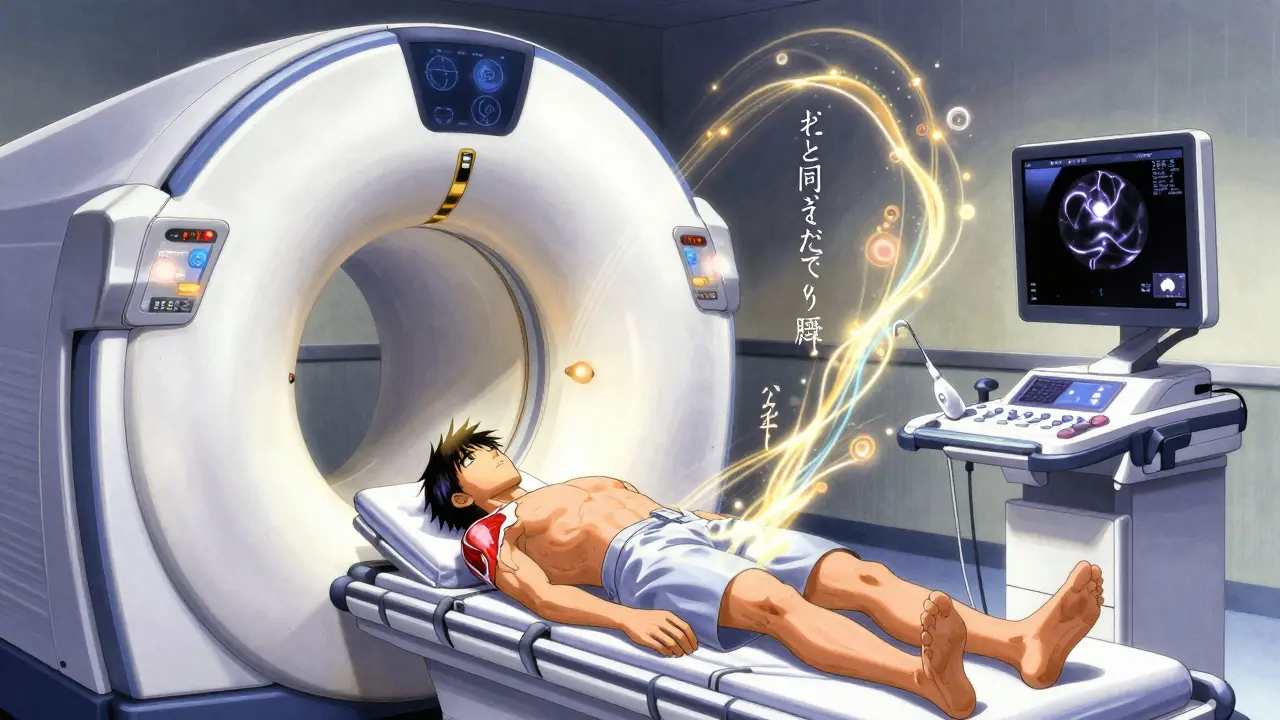
Before any treatment, doctors need to know what they’re dealing with. That starts with a physical exam. They’ll check your range of motion, test your strength with moves like the Empty Can test or Hawkins-Kennedy test, and look for signs of impingement. But physical exams alone can’t tell the full story. That’s where imaging comes in.
X-rays are always the first step. They don’t show tendons, but they reveal bone spurs, arthritis, or changes in the joint that might be contributing to the problem. About 100% of initial evaluations include an X-ray, according to major orthopedic centers.
For soft tissue, you’ve got two main options: MRI and ultrasound.
MRIs are the gold standard for detailed pictures. They show exactly where the tear is, how big it is, and whether it’s partial or full-thickness. MRI accuracy for full-thickness tears is around 92%, with 95% specificity for partial tears. It’s especially useful if surgery is being considered-surgeons need that detailed “road map” of the shoulder.
Ultrasound is cheaper, faster, and just as accurate for many cases. Studies show it catches 87-91% of full-thickness tears, nearly matching MRI’s 91-95%. Plus, it lets the doctor watch the tendon move in real time as you lift your arm. That’s something MRI can’t do. It also costs 30-50% less-$200-$400 versus $500-$1,200-and has no restrictions if you have a pacemaker or metal implants.
But ultrasound has a catch: it depends heavily on who’s doing it. Only about 45% of general radiologists are trained to read shoulder ultrasounds well. In obese patients, the images can get blurry. So if the ultrasound is unclear, or if you’re younger and active with a sudden injury, MRI is usually the next step.
Contrast dye isn’t usually needed for initial scans. It’s only used if you’ve had surgery before and doctors suspect a retear.
Rehabilitation: Can You Heal Without Surgery?
Many people assume a rotator cuff tear means surgery. But that’s not always true. In fact, 85% of people with partial-thickness tears get better with physical therapy alone.
Rehab follows a clear timeline:
- Weeks 1-6: Focus on passive motion. Your shoulder is protected. A therapist moves your arm for you-no lifting, no pushing. This keeps the joint from stiffening.
- Weeks 6-12: You start active-assisted motion. You begin using your own muscles, with help from bands or your other arm. No heavy lifting yet.
- After 12 weeks: Strengthening begins. Exercises target the rotator cuff and scapular muscles. This phase can last 3-6 months.
Studies show that even large tears can stabilize with rehab. The key? Consistency. Skipping sessions or rushing into weights too soon can make things worse.
Doctors now recommend trying 6-8 weeks of physical therapy before ordering an MRI-especially if you’re over 60 and your symptoms are mild. Why? Because many tears are silent. If you’re not in pain and can still do daily tasks, surgery may not help more than rehab.
Surgery: When It’s Needed and What It Involves
Surgery becomes the go-to option if:
- You have a full-thickness tear and you’re under 65
- You’re active-athlete, laborer, or just someone who wants to lift, reach, and move without pain
- Conservative rehab failed after 3-6 months
- The tear is large (>3 cm) or you’ve lost significant strength
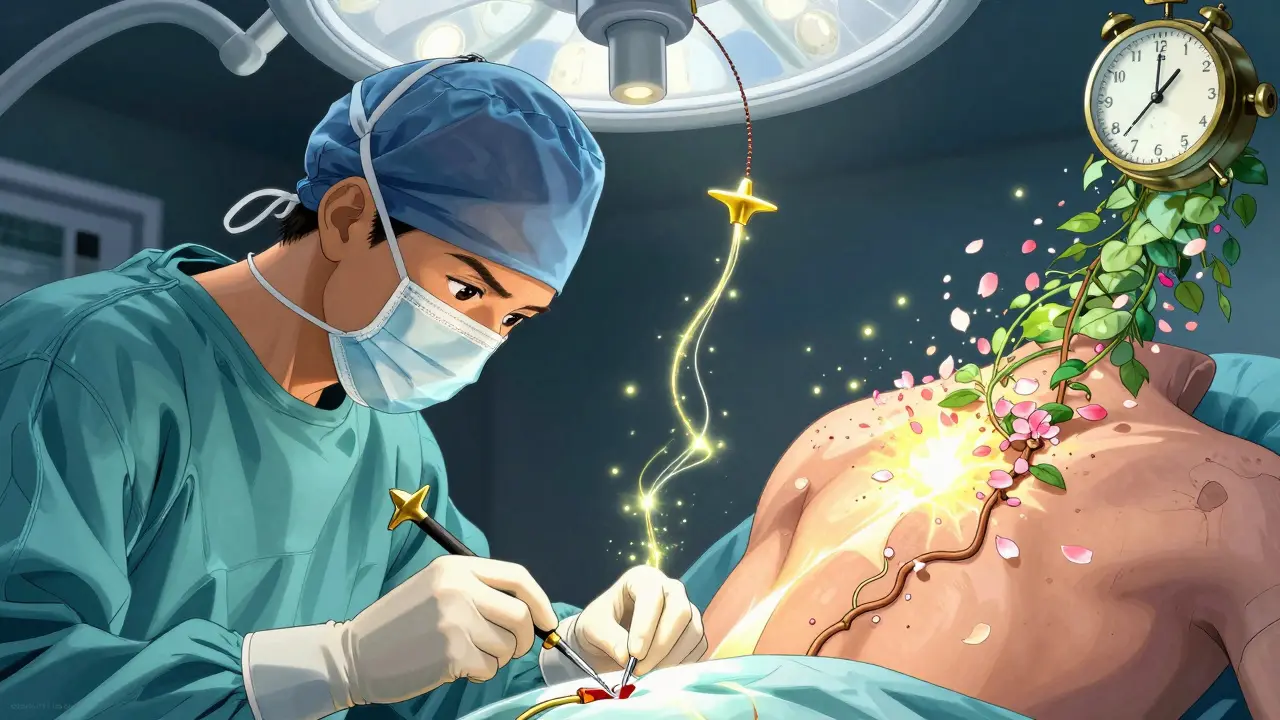
Today, 90% of rotator cuff repairs are done arthroscopically. That means the surgeon makes 3-4 tiny cuts, inserts a camera and small tools, and repairs the tendon with anchors and sutures. It’s less invasive than the old open surgery, which required a big incision.
Arthroscopic repair has 30% fewer complications (7.2% vs. 10.3%) and patients return to daily activities 25% faster. Recovery time has dropped from 6-12 months in the 1990s to 4-6 months now. Why? Because surgeons no longer immobilize the shoulder for weeks. Most patients start passive motion the day after surgery.
For massive tears (over 5 cm), surgeons sometimes use patch grafts or tendon transfers. These are more complex, but they can restore function when the original tendon is too damaged to reattach.
What Happens After Surgery?
Recovery doesn’t end when you leave the hospital. In fact, rehab after surgery is just as important as the surgery itself.
Here’s the typical post-op timeline:
- Weeks 0-6: Sling use only. Passive motion only-no effort from you. Pain and swelling are managed with ice and meds.
- Weeks 6-12: Active motion begins. You start moving your arm on your own, guided by a therapist. No resistance.
- Months 3-6: Strengthening. Light resistance bands, then light weights. Focus on control, not power.
- After 6 months: Return to sports or heavy work, if cleared by your doctor.
Failure to follow this timeline is the #1 reason for retears. Pushing too hard too soon can snap the repaired tendon.
Long-Term Results and Risks
Most people are happy with the results. At five years after arthroscopic repair, 82% report high satisfaction. But retear rates vary by tear size:
- Small tears (<1 cm): 12% retear rate
- Medium tears (1-3 cm): 18% retear rate
- Large tears (>3 cm): 27% retear rate
Age and smoking also raise the risk. Smokers have nearly double the retear rate. So if you smoke, quitting before surgery is one of the best things you can do.
Newer treatments like platelet-rich plasma (PRP) injections are being tried to boost healing. But the Cochrane Review in 2021 found only moderate evidence they help. They’re not standard care yet.
Machine learning is also entering the picture. A 2023 study showed AI could classify tear types on MRI with 89% accuracy-faster and more consistent than human readers. This could soon become routine in radiology departments.
What You Can Do Now
If you’re dealing with shoulder pain:
- Don’t assume it’s just “old age.” Get it checked.
- Start with physical therapy. Give it 6-8 weeks before jumping to imaging.
- If imaging is needed, ask about ultrasound first-it’s cheaper, faster, and just as good for many cases.
- If surgery is suggested, make sure you understand the tear size, your activity goals, and the rehab plan.
- Avoid cortisone shots unless absolutely necessary. They can weaken tendons over time.
Rotator cuff tears aren’t a death sentence for your shoulder. With the right diagnosis, rehab, or surgery, most people get back to their lives-with less pain and more strength than they thought possible.
Hanna Spittel
December 31, 2025 AT 12:33Joy Nickles
January 2, 2026 AT 06:45Emma Hooper
January 2, 2026 AT 13:40Marilyn Ferrera
January 3, 2026 AT 13:28Bennett Ryynanen
January 4, 2026 AT 07:27Chandreson Chandreas
January 6, 2026 AT 05:04Darren Pearson
January 8, 2026 AT 04:07Stewart Smith
January 8, 2026 AT 16:34Aaron Bales
January 10, 2026 AT 07:59Lawver Stanton
January 11, 2026 AT 19:17linda permata sari
January 12, 2026 AT 08:43anggit marga
January 12, 2026 AT 18:45Harriet Hollingsworth
January 14, 2026 AT 04:47Deepika D
January 14, 2026 AT 19:25