
Getting your prescription filled shouldn’t mean driving across town, waiting in line, and sitting through a 20-minute wait just to pick up pills you take every day. For millions of Americans managing chronic conditions - diabetes, high blood pressure, thyroid issues, or even mental health meds - prescription delivery isn’t a luxury anymore. It’s a necessity. And for the 90% of prescriptions in the U.S. that are generics, this service is changing how people stay healthy, one pill at a time.
Why Generics Are the Backbone of Home Delivery
Most people don’t realize that generics make up nearly all of what’s prescribed. In fact, 9 out of 10 prescriptions written in the U.S. are for generic drugs. But here’s the twist: while generics dominate volume, they barely contribute to profits. Prices for these drugs have dropped about 30% over the last decade. That’s great for you - your co-pay might be $5 or even $0. But for pharmacies and delivery services, it’s a squeeze. They’re moving massive quantities of low-margin pills, often with the same delivery cost as a high-priced branded drug. So why does this service still exist? Because people need it.Think about it: if you’re on a daily medication for high cholesterol, you don’t want to forget to refill. You don’t want to miss a dose because you were too tired to drive after work. You don’t want to risk a hospital visit because you ran out. That’s where home delivery shines. Services now sync with your doctor’s e-prescription system, automatically send refill reminders, and ship your meds before you even realize you’re running low. No more last-minute pharmacy runs. No more confusing insurance delays. Just your pills, on time, every time.
How It Actually Works (No Fluff)
Here’s the real process, step by step:- You or your doctor sends an electronic prescription to a pharmacy that offers delivery. This isn’t a fax. It’s instant, secure, and integrated into the national health network.
- The pharmacy checks your insurance. For generics, this usually takes seconds. If there’s a hiccup - like a prior authorization snag - you’ll get a text or app notification. No phone tag.
- Your meds are packed. For most generics, no special handling is needed. No cold chain. No fragile packaging. Just blister packs or bottles, labeled clearly.
- They’re shipped. Most services offer standard 1-3 day delivery. But now, with Walmart and Amazon expanding, same-day delivery is live in 49 states and counting. If you’re in a major metro area, you could get your next refill within hours.
- You get a tracking link. Real-time updates. Delivery confirmation. Even a photo of where the package was left, if you’re not home.
It’s not magic. It’s logistics - and it’s working. IQVIA reports that U.S. prescription use has grown 14% in the last five years. That’s over 215 billion daily doses now being managed. Delivery services are handling a growing slice of that.
Who’s Doing It Best Right Now?
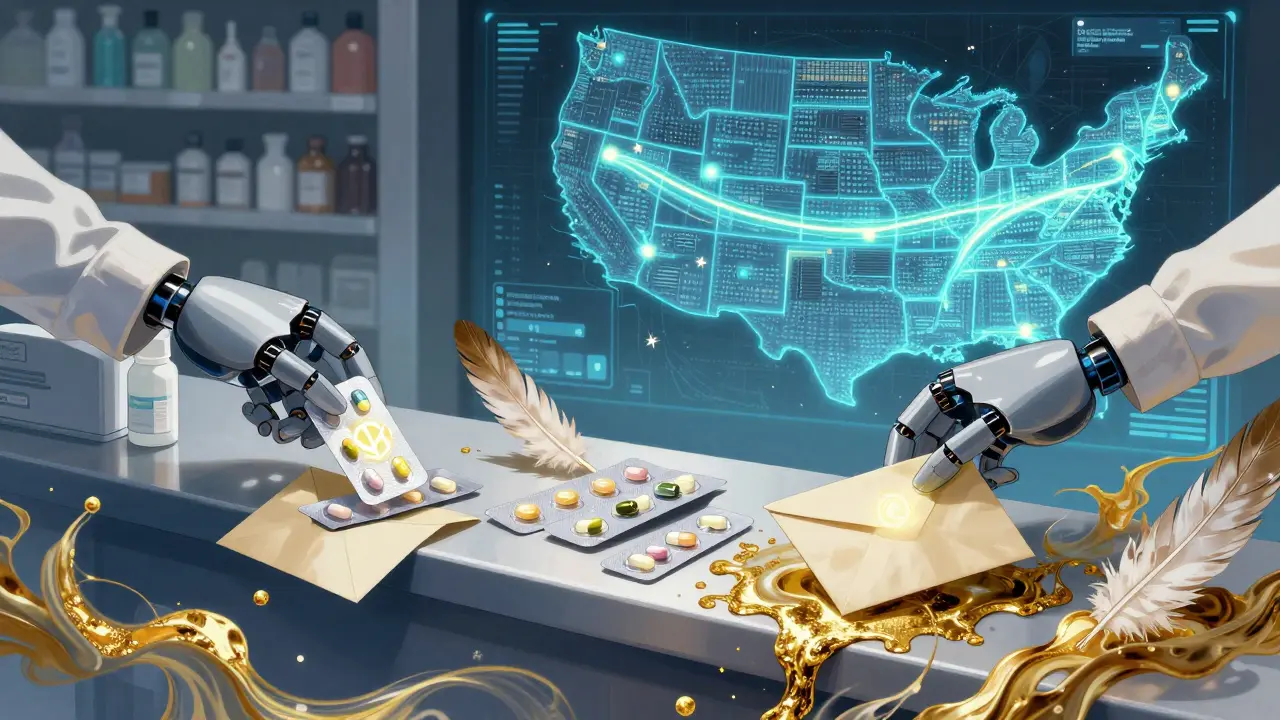
You’ve got three main types of players:- Big Retail Chains (Walmart, CVS, Walgreens): They’re the ones pushing same-day delivery hard. Walmart’s January 2025 rollout to 49 states was a game-changer. If you’ve got a Walmart Pharmacy near you, you can get your generic meds delivered the same day - often within 4 hours. No app needed. Just call, log in online, or use the app. They’re using their existing store network, not building from scratch.
- Digital-First Services (Capsule, Alto, Amazon PillPack): These are slick. Apps with clean interfaces, medication schedules built in, and chat support that actually replies. Alto Pharmacy, for example, sends you a calendar of your refills and lets you pause or reschedule deliveries with one tap. But they’re not everywhere. If you’re outside a major city, you might not even have them as an option.
- Mail-Order Pharmacies (Express Scripts, CVS Caremark): These have been around for decades. They’re reliable for long-term prescriptions - like a 90-day supply of metformin - but they’re slower. You order, wait 5-7 days, get it in the mail. Fine if you’re not in a rush. Not great if you’re out and need a refill tomorrow.
The truth? If you want speed, go with Walmart or a local pharmacy with delivery. If you want control and reminders, go digital. And if you’re on a stable, long-term regimen, mail-order still works.
The Hidden Challenge: Insurance and Admin Hurdles
Here’s where things get messy - and why delivery isn’t perfect yet.Generics are cheap, but insurance claims for them are a nightmare. Because the prices are so low, insurers often require extra steps to approve them. Prior authorization. Step therapy. Formulary checks. A simple refill of lisinopril might get stuck because the system thinks you “should have tried a different generic first.” That delay can mean you’re out of meds for a week. Delivery services can’t fix this - they’re just the courier. But the best ones alert you early. They’ll say: “Your refill is on hold. Your insurer needs a note from your doctor. Here’s a template.” That kind of support? Priceless.
And don’t forget: not all pharmacies can handle controlled substances (like ADHD meds or painkillers) for delivery. Federal rules are strict. Some services still can’t ship them at all. Others require a signature. That’s why you might still need to pick up your Adderall in person - even if everything else comes to your door.
What’s Next? The Future Isn’t Just Faster - It’s Smarter
The next leap isn’t just same-day delivery. It’s smart delivery.Imagine this: your app notices you haven’t opened your pill bottle in three days. It texts: “Still taking your blood pressure med? Need a refill? Your doctor can adjust your dose if needed.” That’s not sci-fi. It’s already happening with services like Capsule and Alto. They’re using simple AI to track adherence - not just delivery. And they’re linking that data to your doctor’s EHR. No more “I thought I took it” excuses.
And as the population ages - over 70 million Americans will be 65+ by 2030 - delivery won’t be optional. It’ll be standard. The same way we expect groceries to be delivered, we’ll expect our meds too. Especially when mobility is limited, transportation is expensive, or caregiving is scarce.
What You Should Do Right Now
Don’t wait for a crisis. If you’re on any regular medication - even a cheap generic - here’s what to do:- Ask your doctor: “Can my prescription be sent to a pharmacy that delivers?” Most can.
- Check Walmart: If you’re in the U.S., they deliver to 49 states. No membership needed. Just enter your zip code on their pharmacy site.
- Set up auto-refill: Most delivery services let you turn on automatic refills. You’ll get a text before it ships. Cancel anytime.
- Use the app: Even if you’re not tech-savvy, the apps are simple. They show your meds, your refill dates, and your delivery status. No phone calls needed.
- Don’t assume mail-order is cheaper: Sometimes, your local pharmacy’s delivery fee is $0. Mail-order might charge $5. Compare before you switch.
The goal isn’t to replace your pharmacy. It’s to make your life easier. And with generics - the most common, most affordable drugs - home delivery isn’t just convenient. It’s keeping people healthy, one delivery at a time.
Can I get my generic prescriptions delivered for free?
Yes, many services offer free delivery, especially for generics. Walmart, CVS, and Walgreens all provide free same-day or next-day delivery with no minimum order. Some digital services like Alto and Capsule also waive delivery fees for members. Always check the pharmacy’s policy - free delivery is common, but not universal.
How fast can I get my meds delivered?
Standard delivery takes 1-3 days. Same-day delivery is now available in most U.S. cities through Walmart and Amazon. If you order before 2 p.m. local time, your meds can be at your door the same day. Rural areas may still take 2-5 days. Always check the delivery window when you place your order.
Are all medications eligible for delivery?
Most are - including generics for blood pressure, diabetes, cholesterol, thyroid, and depression. But controlled substances like opioids, ADHD meds, and certain sleep aids have restrictions. Some services can’t deliver them at all. Others require an adult signature or in-person pickup. Always confirm with the pharmacy before ordering.
Do I need a smartphone to use delivery services?
No. You can order by phone, website, or app. Many seniors use the phone line. Walmart, CVS, and Walgreens all have toll-free numbers for pharmacy orders. You don’t need an app to get your meds delivered. But apps do make it easier to track refills and manage your schedule.
Is home delivery safe for my medications?
Yes. Pharmacies use tamper-evident packaging, temperature-controlled boxes for sensitive meds, and secure delivery methods. Most generics don’t require special handling. For drugs that do - like insulin or GLP-1s - delivery partners use insulated packaging with cold packs. If your meds arrive warm or damaged, call the pharmacy immediately. They’ll replace them at no cost.
Can I switch back to picking up at the pharmacy later?
Absolutely. You’re not locked in. If you want to switch to in-store pickup, just call your pharmacy or update your preferences in the app. Many people use delivery for maintenance meds and pick up occasional prescriptions in person. There’s no penalty for switching.
Lyle Whyatt
February 7, 2026 AT 19:58Man, I wish this existed when my dad was on five different meds for his diabetes and hypertension. He’d forget to refill, then panic when he ran out, then drive 45 minutes to the pharmacy only to find out they were out of stock. We spent more time managing his pills than he spent actually taking them. Now that I’ve got my own scripts on auto-delivery from Walmart? It’s like a weight lifted. No more midnight pharmacy runs. No more ‘did I take it yesterday?’ anxiety. Just a box on the porch, labeled clear as day. And yeah, it’s free. No membership. No BS. I didn’t even know they did this until I Googled it. If you’re on anything daily, just try it. One week. You won’t go back.
MANI V
February 8, 2026 AT 12:52It’s funny how people treat this like some revolutionary breakthrough. We’ve had mail-order pharmacies since the 90s. The only thing that changed is that now big corporations are slapping ‘same-day’ on it like it’s a new invention. Meanwhile, the real issue-the insurance maze, the prior authorizations, the formulary games-is still intact. Delivery services aren’t fixing healthcare. They’re just making it more convenient while the system keeps bleeding people dry. And don’t get me started on how these companies quietly push you toward 90-day supplies so they can lock you in. Convenience is just another word for dependency.
Susan Kwan
February 8, 2026 AT 20:21Oh wow, Walmart’s doing it for free? Who knew? I thought they were just selling cheap socks and rotisserie chickens. Guess I’ll be canceling my CVS subscription tomorrow. /s
Random Guy
February 10, 2026 AT 08:26so like… i just ordered my adderall from walmart and it showed up in 3 hours?? like bro. i was napping and woke up to a package. no signature. no drama. just my little blue pills chillin on the porch like it was amazon prime day. i think my life is now a netflix documentary called ‘how i stopped being a mess and started being a responsible adult.’
Ryan Vargas
February 11, 2026 AT 21:05Let’s be honest: this isn’t about convenience. It’s about control. The pharmaceutical-industrial complex, in partnership with insurers and delivery logistics giants, has engineered a system where your health becomes a data point, not a personal experience. Every refill, every delivery, every app notification-this is surveillance under the guise of care. They track your adherence, correlate it with your insurance claims, and feed it into predictive models that determine your future premiums. The fact that you think this is ‘helping’ is exactly what they want you to believe. The real revolution isn’t delivery-it’s resistance. Opt out. Pick up your own pills. Reclaim your autonomy. Or are you too comfortable with the algorithm?
Tasha Lake
February 12, 2026 AT 15:34Just curious-has anyone here used the integration between Alto and Epic EHR? I’ve been trying to get my endocrinologist to push my scripts through their API, but they say their EHR doesn’t auto-sync with non-CVS partners. Is that still a thing? Or did the interoperability standards finally catch up? I’m trying to automate my T4 and metformin refills, but I keep hitting API walls. Also, do delivery services ever flag drug interactions? Like, if I’m on warfarin and they send me a new OTC supplement, do they alert me? Or is that still on me?
Sam Dickison
February 13, 2026 AT 02:48Biggest win for me? The auto-refill + text reminder combo. I’m on lisinopril and metformin. Used to forget for weeks. Now I get a text 3 days before it’s due. If I don’t reply, they call. If I still don’t answer, they email my emergency contact. My mom got an email last month. She called me crying, thinking I was dying. I had to explain I just forgot to refill. But yeah-no more missed doses. And Walmart’s free delivery? Game changer. I didn’t even know they did it until I tried it. No app. No login. Just call and say ‘I need my blood pressure pills.’ Done.
Brett Pouser
February 14, 2026 AT 08:25I’m from rural Kansas. We don’t have Alto or Capsule here. But Walmart? Yes. And it’s life-changing. My grandma, 78, lives alone. She’s got 6 meds. Used to drive 30 miles to the pharmacy, sit for an hour, then drive back. Now she gets her refills every month. No driving. No waiting. No stress. She says it’s the first time in 10 years she hasn’t missed a dose. And yeah, it’s free. No membership. No fine print. Just a box on the porch. I’m not surprised this works. What’s shocking is that it took this long for it to become common. In places like this, delivery isn’t a luxury. It’s healthcare.
Karianne Jackson
February 14, 2026 AT 10:16my cat knocked over my insulin bottle last week. i panicked. then i remembered i had delivery. ordered a new one. got it in 2 hours. i cried. not because i was scared-because i was so damn relieved. thank you walmart. you saved my life.
Andy Cortez
February 16, 2026 AT 08:11you guys are all missing the point. this isn’t about convenience. it’s about the government and big pharma teaming up to make you dependent. why else would they make it FREE? to get you hooked. now you’re not just taking pills-you’re trusting a system that knows your schedule, your health data, your habits. next thing you know, they’ll start adjusting your doses remotely. or charging you for ‘adherence credits.’ don’t be fooled. free delivery? it’s a trap. they want you to stop seeing your doctor. stop asking questions. just take the box. and that’s how control works.