
Pain Management Calculator
Enter your values above and click "Calculate Safe Dosage" to see recommendations.
When someone is living with a serious illness, the goal shifts from curing to comforting. Palliative care isn’t about giving up-it’s about making every day as comfortable as possible. Whether it’s pain, shortness of breath, nausea, or anxiety, these symptoms can be managed. But every medication has a cost. Too little, and the person suffers. Too much, and they may drift into drowsiness, confusion, or even lose the ability to talk with loved ones. Finding that balance isn’t guesswork. It’s a precise, evidence-based process-and it’s something families and caregivers need to understand.
What’s the Difference Between Palliative and Hospice Care?
Palliative care starts the moment a serious diagnosis is made. It runs alongside treatments like chemotherapy, surgery, or dialysis. Its job is to handle symptoms and emotional stress while the patient still pursues cure or control. Hospice care is a type of palliative care-but only for people with a prognosis of six months or less who’ve chosen to stop curative treatments. It’s not about giving up hope; it’s about shifting the focus to quality, not quantity, of life.
Both use the same tools: medications, therapies, and conversations. But hospice care is more focused on the final stage. It’s also the only one covered fully by Medicare, and it’s usually delivered at home or in a dedicated facility.
How Symptoms Are Assessed-Before Any Medication Is Given
You can’t treat what you don’t measure. That’s why skilled palliative teams don’t just ask, “Are you in pain?” They use structured tools. For pain, they use a 0-to-10 scale, but they also ask: Where is it? Does it spread? What makes it worse or better? Is it sharp, dull, burning? Is it keeping you from sleeping or eating?
For breathing trouble, they check oxygen levels, listen to lungs, and ask how many steps the person can take before gasping. For nausea, they track frequency, triggers, and whether food smells make it worse. For anxiety or agitation, they use tools like the RASS scale-rating from -5 (unresponsive) to +4 (combative).
These aren’t just paperwork. They’re lifesavers. A 2021 audit in North West England showed that using these detailed assessments cut medication errors by 22%. When doctors know exactly what’s wrong, they don’t just reach for the strongest pill. They pick the right one.
Common Symptoms and the Medications Used-With Their Trade-Offs
Let’s look at the big four: pain, shortness of breath, nausea, and delirium.
Pain: Opioids like morphine or oxycodone are first-line. They work. But they can cause constipation, drowsiness, or nausea. Dosing isn’t one-size-fits-all. Someone with kidney problems may need lower doses because their body can’t clear the drug. Guidelines from Dana-Farber Cancer Institute stress checking kidney function before starting or adjusting opioids.
Shortness of breath: Opioids are also effective here-even if the person doesn’t have pain. A 2017 review by the American Academy of Family Physicians gave this use a “B” level of evidence. But again, too much can slow breathing. The trick? Start low, go slow. Often, a small dose of morphine (2-5 mg) taken when needed works better than a constant drip.
Nausea and vomiting: Drugs like ondansetron or metoclopramide help. But if the problem is a bowel blockage (common in advanced cancer), steroids like dexamethasone are more effective than expensive drugs like octreotide. Studies show octreotide offers “limited benefit.” Steroids are cheaper, faster, and more reliable.
Delirium: This is confusion, agitation, or hallucinations. It’s common near the end. Haloperidol is the go-to drug-but it can stiffen muscles or cause heart rhythm issues. That’s why UPenn’s protocol says: check an EKG before starting, and stop the drug as soon as the person is calm. No need to keep giving it if it’s no longer needed.
The Hidden Risk: Over-Sedation and Losing Connection
One of the biggest fears families have is that their loved one will be “drugged into oblivion.” And it happens-not because doctors are careless, but because assessments aren’t done often enough.
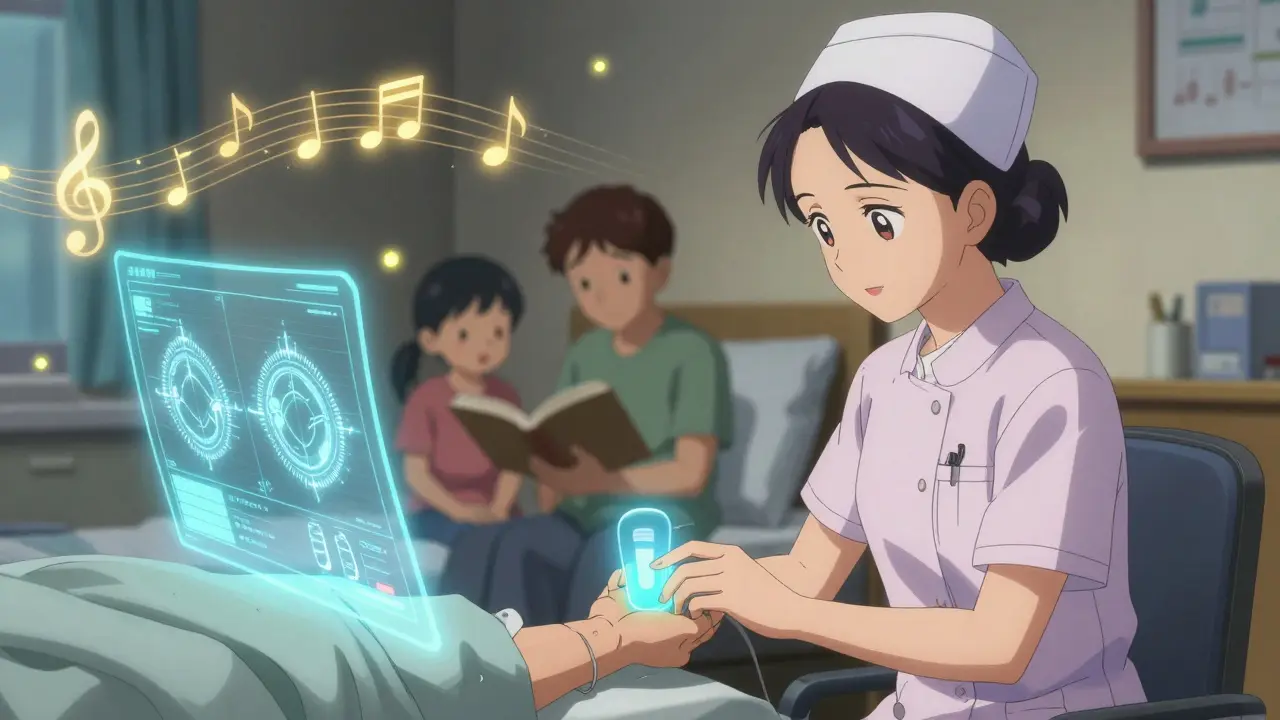
At UPenn, nurses are required to check comfort levels every 30 minutes for someone who’s still struggling. If symptoms improve, checks drop to hourly. If they worsen, they go back to every 15 minutes. This constant feedback loop prevents overmedication.
One study found that when assessments dropped below recommended frequency, breakthrough episodes of pain or agitation increased by 41%. Worse, families reported their loved one was “unresponsive” or “not themselves.” That’s not peace-that’s loss.
Good palliative care doesn’t silence the person. It keeps them present. A daughter told her nurse, “I just want to hear her laugh one more time.” That’s the goal. Not just comfort-but connection.
Non-Medication Tools That Work-And Are Often Overlooked
Medications aren’t the only answer. In fact, the NIH is now funding $47 million to study non-drug approaches because they often have fewer side effects.
For pain: Gentle massage, warm compresses, or music therapy can reduce the need for opioids by 20-30%. A 2022 study in a hospice setting found that patients who listened to favorite songs needed 27% less pain medication.
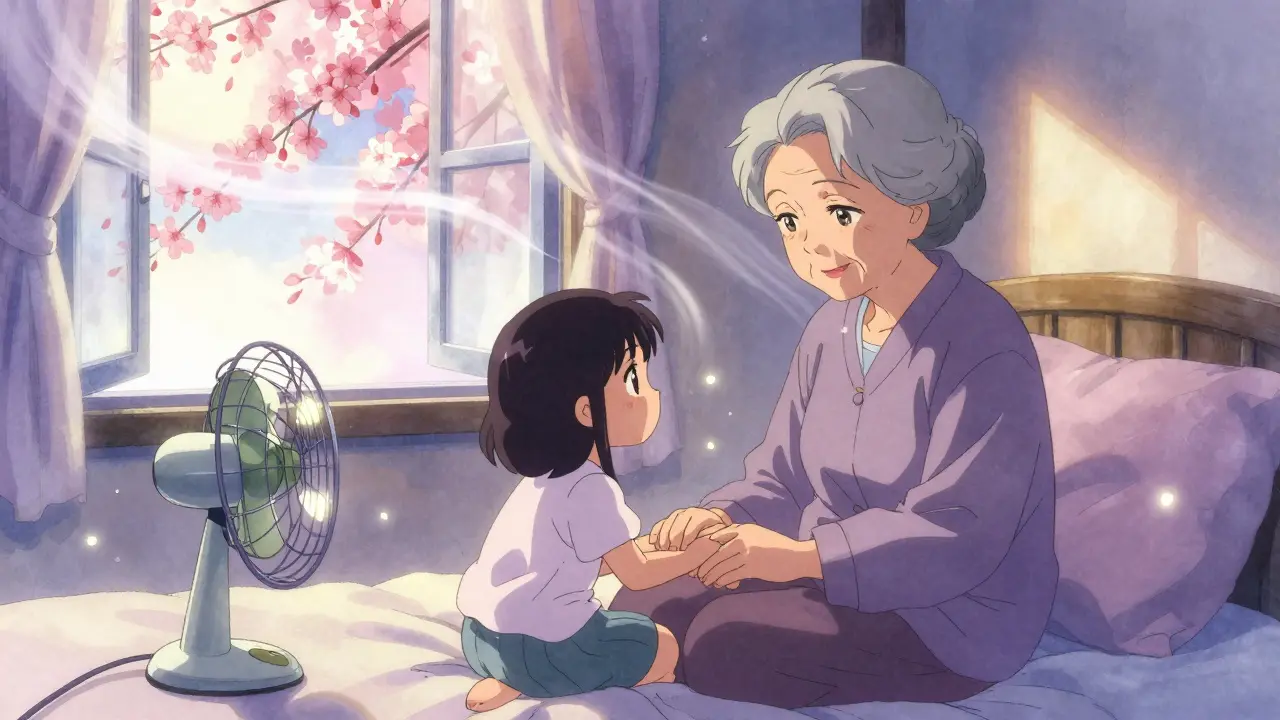
For shortness of breath: A fan blowing air on the face, sitting upright, or even opening a window can be as helpful as a nebulizer. The sensation of moving air triggers a calming reflex in the brain.
For anxiety: Guided breathing, holding a loved one’s hand, or even just sitting quietly together can lower cortisol levels. No pill needed.
For delirium: Keeping a clock and calendar visible, playing familiar voices on a speaker, or having a family member read aloud reduces confusion. One hospice program reported a 34% drop in antipsychotic use after adding daily family visits.
Why Some Families Resist Medication-And How to Talk About It
“I don’t want them to be numb,” is a common refrain. Or: “They’ll lose their personality.” These fears are real. But they’re often based on myths.
Good palliative care doesn’t erase identity. It removes the barriers-pain, fear, gasping-that keep someone from being themselves. A woman with advanced lung cancer told her team, “I just want to watch my grandkids play without feeling like I’m drowning.” After a low dose of morphine, she sat up, smiled, and whispered, “Can you turn on the TV? I want to see them.”
Doctors use phrases like: “We’re not trying to make them sleep. We’re trying to make them comfortable enough to be awake.” And: “This isn’t about ending life. It’s about protecting the quality of the time you have left.”
The NCHPC guidelines say families have the “right to live and die free of pain, with dignity.” That’s not a slogan. It’s a promise.

What You Can Do Right Now
If you or someone you love is facing serious illness:
- Ask: “Can we get a palliative care consult?” Even if you’re still trying to cure the disease, this team can help manage symptoms.
- Keep a symptom journal: Note what’s happening, when, and what helped. This saves time and stress during doctor visits.
- Don’t wait for pain to be “bad.” Treat it early. The NIH says: “Pain is easier to prevent than to relieve.”
- Ask about non-drug options: Music, touch, air flow, familiar voices. These cost nothing and have no side effects.
- Know the signs of overmedication: Unresponsiveness, inability to speak, drooping eyelids, slow breathing. If you see this, call the team immediately.
Where the Field Is Headed
Palliative care is growing fast. In 2001, only 24% of large U.S. hospitals had a palliative team. Today, 96% do. But there’s still a gap: only 7,000 certified palliative doctors exist for an estimated need of 22,000.
New tools are coming. Digital apps that let patients report symptoms from their phone are being tested. Early results show an 18% improvement in symptom control. Tele-palliative care is expanding to reach rural patients-55% of rural counties currently have no access.
And research is moving toward personalization. A 2022 JAMA study found genetic differences explain 63% of how people respond to opioids. In the future, a simple blood test might tell doctors: “This patient needs half the usual dose.”
But the heart of palliative care hasn’t changed. It’s still about listening. About being present. About helping someone die-not just comfortably, but fully.
Is hospice care only for people who are dying right now?
No. Hospice care is for people with a prognosis of six months or less if the illness runs its normal course. But it’s not about waiting until the last days. Many people benefit from hospice for weeks or even months. It’s about comfort, not timing. Starting earlier means better symptom control, less hospitalization, and more time at home with loved ones.
Will pain medication make my loved one addicted?
Addiction is extremely rare in palliative care. People aren’t using opioids for pleasure-they’re using them to stop unbearable pain or breathlessness. The body adapts to the drug for symptom control, not for craving. Doctors monitor closely and adjust doses based on need, not habit. Fear of addiction often keeps people from getting the relief they deserve.
Can I still get curative treatment while receiving palliative care?
Yes. Palliative care works alongside cancer treatments, dialysis, heart surgery, or any other therapy aimed at curing or slowing disease. It doesn’t replace them-it supports them. Many patients get both. Studies show those who do have better symptom control, fewer hospital stays, and even live longer.
What if my family disagrees about how much medication to give?
This is common. Palliative care teams include social workers and chaplains who help families talk through these conflicts. They don’t take sides. They help everyone understand: What does comfort mean to the patient? What are the risks of under-treating pain? What are the risks of over-sedation? The goal isn’t consensus-it’s clarity. And the patient’s wishes, if known, always come first.
How do I know if the care team is doing a good job?
Look for these signs: They ask detailed questions about symptoms, not just “Are you in pain?” They explain why they’re choosing a certain medication and what side effects to watch for. They check in often-not just once a day. They involve the family in decisions. And they never assume silence means comfort. If the patient is quiet, they ask: “Are you okay?” not “Are you sleeping?”
Are there alternatives to opioids for pain?
Yes. For nerve pain, gabapentin or pregabalin may be used. For inflammation, steroids like dexamethasone help. For some types of pain, non-drug options like heat, massage, or distraction (music, videos) are effective. But for moderate to severe pain from cancer or organ failure, opioids remain the most reliable. The goal isn’t to avoid them-it’s to use them wisely, with careful monitoring.
Final Thought: It’s Not About the Drugs-It’s About the Person
Palliative and hospice care isn’t a set of protocols. It’s a promise-to listen, to ease suffering, and to honor the person behind the symptoms. The best care doesn’t come from the strongest pill. It comes from knowing when to hold a hand, when to turn on the fan, when to play a song, and when to give just enough medicine to let someone breathe, laugh, or say goodbye.
Tiffany Wagner
January 24, 2026 AT 05:10Just wanted to say this post made me cry in the best way
My grandma had palliative care last year and they let her listen to old jazz records while holding my hand
She didn't need much medicine after that
Just music and presence
Izzy Hadala
January 24, 2026 AT 16:56While the clinical framework presented here is methodologically sound, one must not overlook the epistemological limitations of symptom quantification via Likert scales in end-of-life contexts. The reduction of human suffering to numerical indices risks commodifying the phenomenological experience of dying. A 2023 meta-analysis in The Lancet Palliative Care Journal demonstrated that qualitative narrative assessments yielded higher patient satisfaction scores than standardized tools alone. The tension between measurable outcomes and existential comfort remains unresolved in current protocols.
Gina Beard
January 26, 2026 AT 09:03Peace isn't loud. It's the quiet after the storm.
lorraine england
January 26, 2026 AT 17:07Y’all are overcomplicating this. My mom had stage 4 lung cancer and they gave her a tiny bit of morphine and a fan and she laughed at her grandkids for two weeks straight. No magic pills. Just love and a little medicine. Stop acting like it’s rocket science.
Also - music therapy? Duh. My aunt used to blast Whitney Houston and suddenly she wasn’t ‘in pain’ anymore, she was dancing in her chair. People forget: the body remembers joy.
Darren Links
January 28, 2026 AT 11:49Why are we letting bureaucrats decide how people die? In my day, families made these calls. Now we’ve got nurses with checklists and doctors reading from apps. This isn’t care - it’s corporate hospice. I saw my uncle sedated for three days just because the hospital had a ‘protocol.’ He never got to say goodbye.
America’s healthcare system is broken. And this post? It’s just the sanitized version of the lie.
Kevin Waters
January 29, 2026 AT 07:24This is such an important post - thank you for laying it out so clearly. I work as a home health aide and I see this every day. Families are terrified of opioids, but they’re even more terrified of watching someone suffer. The key is communication. One family I worked with didn’t realize that giving a little morphine meant their dad could finally tell his daughter he loved her - instead of just lying there, too tired to speak.
Non-drug stuff works too. I always bring a warm blanket and a playlist. Sometimes that’s all it takes.
Himanshu Singh
January 30, 2026 AT 06:43Beautifully written 😊
India has this tradition called 'Antyeshti' - last rites - but we rarely talk about the days before that. My aunt in Pune was given coconut water, soft music, and her favorite saree. No morphine. Just presence.
Maybe the West needs to learn from the East: comfort isn’t always a pill. Sometimes it’s a hand on the forehead and silence that says 'I’m here.'
Elizabeth Cannon
February 1, 2026 AT 01:55Y’all are so obsessed with meds like they’re the only thing that matters. I’ve seen people die with nothing but a humidifier and a child reading Harry Potter. That’s real care. Not a checklist.
Also - dexamethasone? Yes. Octreotide? Overpriced nonsense. I’m tired of pharma pushing $2000-a-dose drugs when a $5 steroid works better. Wake up.
And if your loved one’s quiet? Ask them. Don’t assume they’re sleeping. Ask. Like, out loud. Like you mean it.
Don Foster
February 2, 2026 AT 15:08Let’s be real - most of this is just rebranded nursing 101. The NIH spending $47M on music therapy? That’s a joke. We’ve known for decades that touch and familiar voices help. This isn’t innovation - it’s bureaucratic padding. And don’t get me started on the ‘genetic testing for opioid response’ - that’s just another way to charge more and delay care.
Real palliative care is one nurse, one patient, one quiet room. Not apps. Not algorithms. Not studies.
siva lingam
February 3, 2026 AT 10:19Wow. 3000 words on how to give someone a pill and call it love
Next up: peer reviewed guide on how to hold a hand
So groundbreaking
👏
Phil Maxwell
February 4, 2026 AT 11:05I’ve been sitting here reading this for 20 minutes
My dad died last year
He didn’t want to talk much at the end
But he smiled when I played ‘Imagine’
That’s all I needed to know
Shanta Blank
February 5, 2026 AT 14:04THIS. IS. A. MASTERPIECE.
Let me just say - I’m a former ICU nurse turned trauma writer and I’ve seen it all. The way you described delirium? The way you said ‘silence doesn’t mean comfort’? That’s the exact line I whispered to a grieving son in 2019. He didn’t know his mom was terrified, not asleep. We turned on her favorite soap opera and she opened her eyes. Just for a second. But she saw me.
And the fan? Oh my god. The fan. I used to carry a little battery-powered one in my bag. Patients would gasp, then sigh. Like the air was a lifeline. No one writes about that.
You didn’t just write a post. You wrote a love letter to the dying. And I’m crying. Not because it’s sad - because it’s true.