
Myxedema coma isn’t just a rare complication of hypothyroidism-it’s a ticking clock. Every hour without treatment raises the risk of death by 10%. This isn’t a slow decline. It’s a sudden, silent collapse of the body’s most basic functions: breathing slows, heart rate drops, body temperature plummets, and the mind slips into confusion-or worse, coma. And here’s the brutal truth: many patients are misdiagnosed for months, even years, before this crisis hits. If you or someone you know has been told they’re just "getting older," "depressed," or "lazy," and they’re constantly cold, lethargic, and confused, this could be the warning sign you’ve been missing.
What Exactly Is Myxedema Coma?
Myxedema coma, now more accurately called myxedema crisis, is the body’s final breakdown from untreated or poorly managed severe hypothyroidism. It’s not a single symptom. It’s a cascade. The thyroid isn’t just underperforming-it’s nearly silent. Without enough T3 and T4 hormones, your metabolism stalls. Your cells stop producing energy. Your brain slows. Your heart can’t pump efficiently. Your lungs can’t respond to low oxygen or high carbon dioxide. And your body can’t regulate its own temperature.
It’s not just about feeling tired. It’s about being unable to wake up. About shivering uncontrollably in a warm room. About your breathing becoming so shallow that oxygen levels drop dangerously low. About your sodium levels crashing, your kidneys failing, and your gut shutting down completely. The classic signs? Altered mental status (confusion, drowsiness, coma), core body temperature below 95°F (35°C), and a clear trigger-like an infection, cold exposure, or stopping thyroid medication.
What makes this so dangerous is how easily it’s mistaken for something else. Elderly patients often don’t show the textbook symptoms. They might not look pale or puffy. They might just seem "off"-withdrawn, forgetful, unresponsive. Doctors may think it’s dementia, stroke, or a psychiatric episode. But behind that quiet demeanor is a body starving for thyroid hormone.
Who’s at Risk-and Why?
Myxedema coma doesn’t strike randomly. It targets people who’ve had untreated or poorly controlled hypothyroidism for years. Most patients are women over 60. The female-to-male ratio is about 3:1, but men are more likely to be misdiagnosed because the condition is seen as "a woman’s disease." That delay kills.
The biggest risk factor? Stopping thyroid medication. About 47% of cases happen after a hospital stay where thyroid pills were accidentally discontinued. Infections are the second most common trigger-pneumonia and urinary tract infections account for 30-50% of cases. Cold weather plays a huge role too. In winter, the body’s demand for heat rises, but without thyroid hormone, it can’t generate it. That’s why cases spike in colder months and in northern climates. Scandinavian countries report 50% more cases than Mediterranean regions.
Uninsured patients face even higher risks. Studies show they wait 35% longer for treatment and have 22% higher death rates. Why? Delayed diagnosis. Fewer follow-ups. Medication costs. These aren’t just statistics-they’re real people falling through the cracks.
How Is It Diagnosed? (And Why Lab Tests Can’t Wait)
There’s no single blood test that confirms myxedema coma. That’s why doctors can’t wait for results. You diagnose it by connecting the dots in real time.
Here’s what you’ll typically see:
- Severe hypothermia: Core temperature below 95°F (35°C)
- Low T4: Free T4 below 0.9 ng/dL
- Very high TSH: Often over 100 mIU/L (normal is 0.4-4.0)
- Hyponatremia: Sodium below 135 mmol/L-seen in 70-80% of cases
- Respiratory failure: Respiratory rate under 12 breaths per minute, high CO2 (PaCO2 >45 mmHg), low oxygen (PaO2 <80 mmHg)
- Bradycardia: Heart rate below 60 bpm
- GI ileus: Bowels stop moving-40-60% of patients develop this
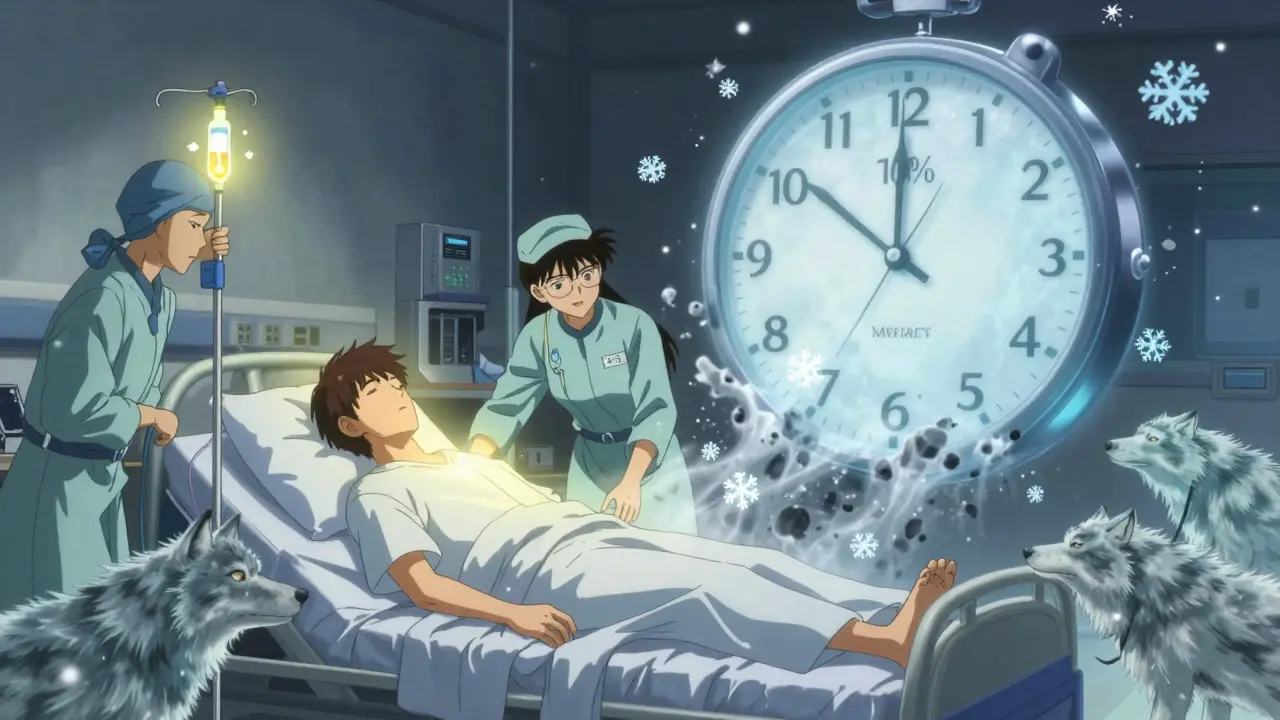
But here’s the catch: you don’t wait for labs. The American Thyroid Association and Endocrine Society both say: if you suspect myxedema coma, treat it immediately. Don’t wait for TSH results. Don’t wait for a CT scan. Don’t wait for a psychiatric consult. The longer you wait, the higher the chance of death. Studies show mortality increases by 10% for every hour of delay.
Emergency Protocol: The 5-Step Lifesaving Plan
There’s no room for hesitation. The goal? Restore thyroid hormone fast-and protect the body while you do it. Here’s what works:
- Secure the airway: About 50-70% of patients need intubation because their breathing is too weak. Don’t wait for respiratory arrest. If they’re lethargic and breathing shallowly, intubate early.
- Give IV thyroid hormone immediately: Start with 300-500 mcg of intravenous levothyroxine (T4). In severe cases, especially with heart problems, add 10-20 mcg of liothyronine (T3) every 8 hours. Newer guidelines now favor T3 in high-risk cases because it works faster. A 2022 trial showed a 15% drop in 30-day death rates when T3 was used early.
- Warm gently: No heating blankets, no warm baths. Active rewarming can cause dangerous drops in blood pressure. Use warm blankets, increase room temperature, and monitor core temperature every 30 minutes. Let the body warm slowly as hormone levels rise.
- Treat the trigger: Assume infection until proven otherwise. Start broad-spectrum antibiotics right away-pneumonia and UTIs are the most common culprits. Use the DIMES mnemonic: Drugs, Infection, Myocardial infarction/CVA, Exposure to cold, Stroke. Find and fix the trigger.
- Correct electrolytes slowly: Hyponatremia is common, but correcting sodium too fast can cause brain damage. Limit correction to 4-6 mmol/L in the first 24 hours. Don’t rush it.
And here’s what you must avoid: corticosteroids unless adrenal insufficiency is confirmed. Giving steroids without testing can mask adrenal crisis, which often coexists. Always check cortisol levels before giving hydrocortisone.
What Happens After Treatment?
Patients who get treated fast often turn around in 24-48 hours. Confusion lifts. Temperature rises. Breathing improves. But recovery isn’t instant. Many need weeks in the ICU. Some require long-term ventilation. And many never fully regain their previous level of function.
Long-term survival depends on two things: consistent thyroid hormone replacement and avoiding triggers. Patients who stop their meds after discharge are at high risk for recurrence. A 2022 survey of 427 hypothyroid patients found 18% had experienced a near-miss-usually because they skipped pills during a hospital stay or ignored worsening symptoms.
For those who survive, ongoing care is non-negotiable. Regular TSH checks. Medication adherence. Education for family members. And awareness: if you’re hypothyroid, never stop your meds without consulting your doctor-even during a hospital stay.
Why This Matters Now More Than Ever
The global population is aging. The 2023 Global Burden of Disease Study predicts a 20% rise in myxedema coma cases by 2030. More elderly people mean more undiagnosed hypothyroidism. More people on medications that interfere with thyroid function. More cases hidden behind the assumption that fatigue and forgetfulness are just part of getting older.
And technology is catching up. In January 2023, the FDA approved a new IV thyroid hormone formulation with faster absorption. Point-of-care thyroid tests are in late-stage trials-they could give results in 15 minutes, not 6 hours. That’s huge. But until those tools are everywhere, the most powerful tool remains: clinical suspicion.
If you’re a clinician: when an elderly patient presents with unexplained lethargy, low temperature, or hyponatremia-think myxedema. Don’t dismiss it as depression. Don’t wait for labs. Treat like it’s a heart attack.
If you’re a patient or caregiver: know your numbers. Know your meds. If you feel worse after a hospital stay, after an infection, or during winter-speak up. Say: "I think this might be my thyroid."
Myxedema coma doesn’t announce itself. It creeps in. But with awareness, speed, and the right protocol, it doesn’t have to end in tragedy.
Can myxedema coma be prevented?
Yes, in most cases. The key is consistent thyroid hormone replacement and avoiding triggers. Never stop your medication without consulting your doctor, especially during hospitalizations. If you have hypothyroidism, get your TSH checked every 6-12 months. Watch for signs of worsening-increased fatigue, cold intolerance, confusion, swelling-and seek help early. Infections and cold exposure are major triggers; treat infections quickly and stay warm in winter.
Is myxedema coma the same as thyroid storm?
No. They’re opposites. Thyroid storm is caused by too much thyroid hormone-leading to fever, rapid heart rate, high blood pressure, and agitation. Myxedema coma is caused by too little-leading to low temperature, slow heart rate, low blood pressure, and lethargy. Treatment is completely different: thyroid storm needs drugs to block hormone production, while myxedema coma needs hormone replacement. Confusing the two can be deadly.
Why do elderly patients often get misdiagnosed?
Because their symptoms don’t match the textbook picture. Older adults often have "apathetic hypothyroidism"-they don’t look puffy or tired in the classic way. Instead, they seem withdrawn, confused, or depressed. Doctors may attribute it to dementia, depression, or normal aging. But underlying hypothyroidism is often the real cause. This delay in diagnosis is why elderly patients have higher mortality rates.
What’s the most common mistake in treating myxedema coma?
Delaying thyroid hormone replacement while waiting for lab results. Many clinicians wait hours for TSH or free T4 levels to come back. But by then, the patient may be too far gone. The guidelines are clear: if clinical suspicion is high, give IV levothyroxine immediately. Treatment should begin within 30 minutes of suspicion. Waiting for labs is the leading cause of preventable death.
Can you survive myxedema coma without treatment?
No. Without immediate treatment, myxedema coma is almost always fatal. Mortality rates range from 25% to 60% even with proper care. Without treatment, death usually occurs from respiratory failure, cardiac arrest, or multi-organ failure. It’s not a condition that resolves on its own. Every minute counts.
Johanna Baxter
January 8, 2026 AT 20:44This is why I stopped trusting doctors after my mom died from this. They called it "old age" for two years until she couldn't wake up. No labs needed to tell me something was wrong. Just look at her.
She was shivering in a blanket in 75-degree heat.
Kiruthiga Udayakumar
January 10, 2026 AT 09:24Ugh. I’ve seen this so many times in India. Elderly women told they’re just "tired from housework" while their TSH is off the charts. No insurance? No follow-up? No meds? They just fade away. It’s not medical neglect-it’s cultural blindness. We don’t treat thyroid like a life-or-death thing here. We treat it like a "maybe tomorrow" problem.
My aunt was like this. She stopped taking pills because they "cost too much" and died in her sleep. No one even noticed until the smell came.
Stop calling it rare. It’s just hidden.
Patty Walters
January 11, 2026 AT 17:30Just want to add-if you’re ever in the ER and someone looks like they’re in a daze, cold as ice, and won’t respond? Don’t wait for labs. Push for TSH and free T4 immediately. I’m a nurse and I’ve seen this go wrong so many times because everyone assumes it’s dementia or depression. The moment you see hypothermia + altered mental status + low sodium? Start treatment. Don’t wait.
And yes, even if the patient doesn’t look "classic"-that’s the whole damn point.
Also, if you’re on levothyroxine? Never skip. Even for a day. Especially after surgery or infection.
Save a life. Be loud.
Diana Stoyanova
January 12, 2026 AT 09:04Okay but let’s be real-this isn’t just about medicine. It’s about how we treat aging women. We tell them they’re lazy, depressed, or just getting old. We don’t listen. We don’t test. We don’t care enough to dig deeper. My grandma was like this. She was told she just needed more sleep. She was 82. She didn’t sleep. She was dying.
And now I’m screaming into the void because no one listens until it’s too late.
Thyroid isn’t a "women’s issue." It’s a human issue. And if your body can’t make heat, you’re one cold snap away from death. That’s not dramatic. That’s biology.
Stop normalizing suffering. Test. Treat. Listen.
tali murah
January 14, 2026 AT 00:32Let me guess-this post was written by someone who had a relative die from this and now they’re on a martyr complex. Classic. You’re not special for noticing a rare complication. It’s called medicine. We have protocols. We have labs. We have guidelines.
And yes, people die. People die from heart attacks, strokes, overdoses, and yes-even hypothyroidism. But this isn’t some hidden conspiracy. It’s a known risk in a known population.
Stop weaponizing grief to make yourself feel morally superior.
Also, the stats you cited? Where’s the source? I’m not buying this emotional manipulation.
Pooja Kumari
January 15, 2026 AT 04:59Oh my god I’m crying. I’ve been on levothyroxine for 14 years and I still forget to take it sometimes because I feel fine. But then I get so tired I can’t get out of bed. My hands are always cold. My hair falls out in clumps. I thought it was stress. I thought I was just lazy. My doctor said I was "overreacting" because my TSH was "only" 8.5. Eight point five. That’s not normal. That’s not fine. That’s a warning light flashing red and everyone’s like, "Eh, maybe next month."
My cousin in Delhi had this. She was 68. She stopped her meds after her husband died. She was found in bed, barely breathing. They said it was pneumonia. But her TSH was 217. They didn’t test until she was in ICU.
And now I take my pill every morning like my life depends on it. Because it does.
And if you’re reading this and you’ve been told you’re just "getting older"? Go get your thyroid checked. Don’t wait. Don’t be polite. Demand the test. Your life isn’t a suggestion.
Phil Kemling
January 15, 2026 AT 18:01There’s a quiet horror in how the body shuts down silently. No scream. No dramatic collapse. Just… less. Less warmth. Less movement. Less thought. The thyroid doesn’t scream for help-it whispers. And we’ve trained ourselves to ignore whispers.
We celebrate loud pain. We rush to the ER for chest pain. But a slow fade? A mind slipping into fog? A body that can’t stay warm? That’s not dramatic enough for our culture.
Myxedema coma isn’t just a medical event. It’s a philosophical one. It forces us to confront how little we value the invisible suffering of the elderly, the poor, the forgotten.
We don’t fail to treat it because we lack knowledge. We fail because we lack empathy.
And that’s the real crisis.
Jerian Lewis
January 17, 2026 AT 04:06People act like this is new. It’s not. It’s been documented since the 1800s. The fact that we’re still missing it in 2025 says more about our healthcare system than it does about the disease.
Doctors are overworked. Patients are under-insured. Labs take days. Insurance denies tests. And the people who need help the most? They’re the ones who can’t fight the system.
It’s not about individual negligence. It’s systemic. And until we fix that, this will keep happening.
Stop blaming doctors. Stop blaming patients. Fix the machine.
Jenci Spradlin
January 18, 2026 AT 12:36just a quick heads up-dont forget to check for hyponatremia and co2 retention. if they’re slow breathing and sodium’s low, treat like it’s myxedema even if tsh isnt back yet. i’ve seen cases where tsh was normal because they’d just taken a pill that morning. but their body was already crashing. don’t wait for perfect labs. treat the person.
also-keep the heat on. dont wait for the hospital. wrap them in blankets. even if they say they’re hot. they’re not. their brain is broken.
Elisha Muwanga
January 18, 2026 AT 15:51Why are we even talking about this? In America, we have the best healthcare in the world. If someone can’t afford meds, that’s a political problem, not a medical one. Stop using this to bash the system. People die from everything. This is just one more. Get over it.
Also, why are you assuming everyone’s from the US? My family’s from Uganda. We don’t have thyroid meds. We have faith. And we survive. Maybe we don’t need your fancy labs.
Stop making everything about your guilt trip.