

What Are Inactive Ingredients in Generic Medications?
You might think a pill is just the medicine inside. But here’s the truth: inactive ingredients make up most of what you swallow. In many pills, over half the weight isn’t the drug at all-it’s fillers, dyes, preservatives, and sugars. For generic medications, these ingredients can change every time you refill your prescription, even if the active drug stays the same.
The FDA calls them "excipients," and they’re not optional. They help the pill hold its shape, dissolve at the right time, taste better, or last longer on the shelf. But here’s the catch: while the active ingredient in a generic must match the brand-name version exactly, the rest? It’s a free-for-all. A generic version of your blood pressure pill might use lactose as a filler. The next one, made by a different company, might use cornstarch. Neither is dangerous for most people. But for someone with a sensitivity? That switch can cause real problems.
Why Do Generic Drugs Have Different Inactive Ingredients?
It’s not a loophole-it’s the law. The FDA requires generic drugs to be bioequivalent to the brand-name version. That means they deliver the same amount of active ingredient into your bloodstream at the same rate. But the agency doesn’t require the same fillers, coatings, or colors. Why? Because the focus is on performance, not packaging.
Generic manufacturers don’t need to repeat the expensive clinical trials brand-name companies do. Instead, they file an Abbreviated New Drug Application (ANDA). It’s faster, cheaper, and lets competition drive prices down. And it works: generics now make up 90% of prescriptions filled in the U.S., but only 23% of drug spending. That’s a win for consumers.
But here’s what gets overlooked: while the active ingredient is tightly controlled, the inactive ones aren’t. One company might use sodium metabisulfite to preserve the pill. Another might use talc. Neither is banned. Neither needs a warning label. And unless you’re reading the fine print on the bottle, you won’t know the difference until you start feeling off.
What Inactive Ingredients Can Cause Problems?
Most people never notice a difference. But for a significant number, the problem is real. According to a 2019 MIT and Brigham and Women’s Hospital study, nearly all medications contain at least one ingredient that some patients can’t tolerate. Here are the most common culprits:
- Lactose - Found in about 20% of oral medications. A problem for people with lactose intolerance, which affects up to 68% of adults globally.
- Gluten - Not always labeled, even when present. A risk for those with celiac disease or non-celiac gluten sensitivity.
- FODMAP sugars - Like lactose, fructose, and sorbitol. These trigger bloating, cramps, and diarrhea in people with IBS. About 55% of medications contain them.
- Bisulfites - Used as preservatives. Can cause asthma attacks in sensitive individuals. The FDA requires warning labels on these, but only if they’re above a certain threshold.
- Artificial dyes - Red 40, Yellow 5, Blue 1. Linked to skin rashes and hyperactivity in children. Often used to make pills look different from the brand version.
- Peanut oil - Rare, but still used in some liquid or topical formulations. Manufacturers must label it, but it’s not always obvious.
These aren’t rare edge cases. A 2020 study in PubMed Central found that a majority of medications contain ingredients that can trigger adverse reactions-even at doses as low as a few milligrams. For someone with multiple allergies or chronic conditions, finding a pill that avoids all these triggers can be nearly impossible.
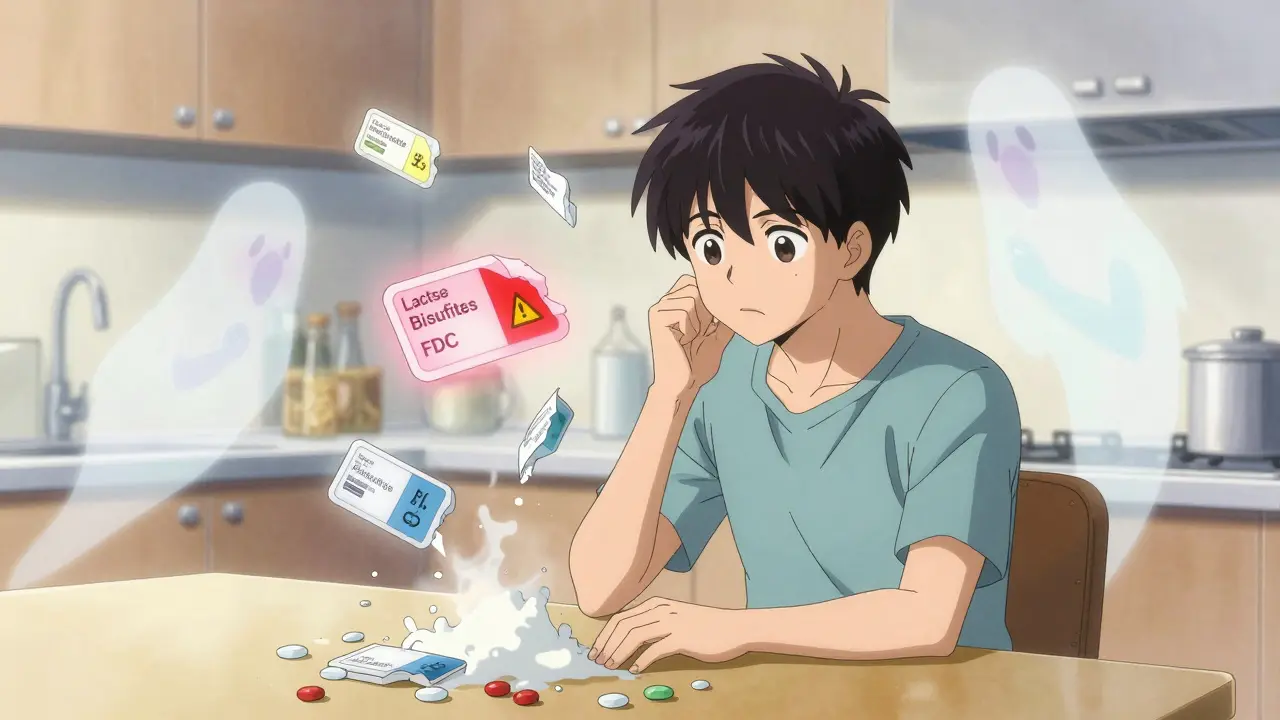
Real Stories: When Switching Generics Backfired
Online forums are full of stories that don’t show up in clinical trials. On Reddit’s r/pharmacy, one user wrote: "After switching to generic levothyroxine, I got severe stomach cramps, fatigue, and brain fog. I switched back to Synthroid-and everything cleared up in a week."
Another person on a thyroid support group shared: "My doctor said generics are the same. But when I went from one generic to another, my heart started racing. I checked the ingredients-different binders. I switched back and it stopped. No one believed me until I showed them the label." These aren’t just anecdotes. A MedShadow survey in 2022 found that 27% of people who switched to generics reported new side effects. Of those, 68% blamed the inactive ingredients. The FDA’s own adverse event database has hundreds of reports tied to fillers and dyes-though proving direct causation is hard.
One study on blood pressure meds found that after generics hit the market, adverse event reports jumped: 8% for losartan, 12% for valsartan, 14% for candesartan. The researchers couldn’t say for sure if it was the inactive ingredients, but the timing was too consistent to ignore.
How to Protect Yourself
You don’t have to avoid generics. But you do need to be smart about them. Here’s how:
- Check the label - Every prescription bottle lists inactive ingredients. It’s usually in small print on the side or back. If you’re unsure, ask your pharmacist to print the full list.
- Know your triggers - If you have celiac disease, lactose intolerance, or severe allergies, keep a list of ingredients you can’t tolerate. Bring it to every appointment.
- Ask your pharmacist - They can tell you which generic version you’re getting and whether it contains your problem ingredients. Some pharmacies even keep a database of inactive ingredients by manufacturer.
- Don’t switch without telling your doctor - If you’ve had a bad reaction to a generic before, ask your doctor to write "Dispense as Written" or "Do Not Substitute" on the prescription.
- Use the FDA’s Inactive Ingredient Database - It’s not user-friendly, but it’s free. Search by drug name and you’ll see all approved excipients for each version.
For people on five or more medications-common among older adults-this gets complicated fast. Every pill adds another chance for a bad interaction. One person might be fine with lactose in their blood pressure pill, but if their thyroid med has it too, the total dose adds up. That’s when symptoms creep in: fatigue, bloating, rashes-and doctors often blame it on aging or stress.
Is There a Better Way?
The system isn’t broken-it’s outdated. The FDA approves ingredients based on safety for the average person. But what about the 1 in 10 with allergies? The 1 in 7 with IBS? The 1 in 100 with celiac disease?
Some companies are starting to respond. A few generic makers now offer "hypoallergenic" versions-free of dyes, gluten, and lactose. They cost a little more, but for people who’ve suffered side effects, it’s worth it. Insurance doesn’t always cover them, but sometimes a letter from your doctor can get it approved.
MIT researchers are building a public database that maps inactive ingredients across all FDA-approved drugs. It’s still in development, but once live, it could let you search: "Show me all levothyroxine pills without lactose or FD&C Red 40." That kind of transparency could change everything.
For now, the burden is on you. You’re not being paranoid. You’re being informed. And in a system that treats pills like commodities, that’s the only protection you’ve got.
When to Stick With Brand-Name Drugs
There’s no shame in choosing brand-name medication. If you’ve tried generics and had consistent issues, your doctor can justify sticking with the original. Insurance might push back, but many plans have exceptions for patients with documented adverse reactions.
Some drugs are more sensitive to formulation changes. Levothyroxine (for thyroid), warfarin (for blood thinning), and certain seizure meds are often flagged by doctors as ones to avoid switching. That’s not because generics are unsafe-it’s because the margin for error is tiny. Even a 4% difference in absorption can throw off your entire treatment.
If you’re on one of these drugs, don’t assume generics are interchangeable. Ask your doctor: "Is this one of those meds where the filler matters?" If they hesitate, that’s your answer.
Chris & Kara Cutler
February 1, 2026 AT 23:28Switched generics last month and now I feel like a new person.
vivian papadatu
February 2, 2026 AT 01:21Rachel Liew
February 3, 2026 AT 20:02Naomi Walsh
February 5, 2026 AT 13:12franklin hillary
February 5, 2026 AT 23:02Bryan Coleman
February 6, 2026 AT 01:35Sami Sahil
February 6, 2026 AT 11:31Bob Cohen
February 7, 2026 AT 05:53Jamie Allan Brown
February 8, 2026 AT 12:25Nicki Aries
February 9, 2026 AT 23:01Naresh L
February 10, 2026 AT 13:56franklin hillary
February 12, 2026 AT 08:11