
If you’ve ever paid $150 for a prescription you thought should cost $20, you’re not alone. In the U.S., the same medication can cost three times more at one pharmacy than another - even if they’re right next door. This isn’t a glitch. It’s how the system works. And the good news? You can beat it.
You don’t need insurance. You don’t need a coupon book. You just need to know where to look - and how to ask the right questions. The key is shopping around like you would for gas or groceries. Because when it comes to prescriptions, price isn’t fixed. It’s negotiable.
Why Prices Vary So Much
Pharmacies don’t set their own prices. They get them from Pharmacy Benefit Managers (PBMs) - middlemen between drug makers and pharmacies. PBMs negotiate bulk discounts, but those savings rarely show up at the counter. Instead, each pharmacy sets its own cash price based on what they’re willing to accept to move the product.
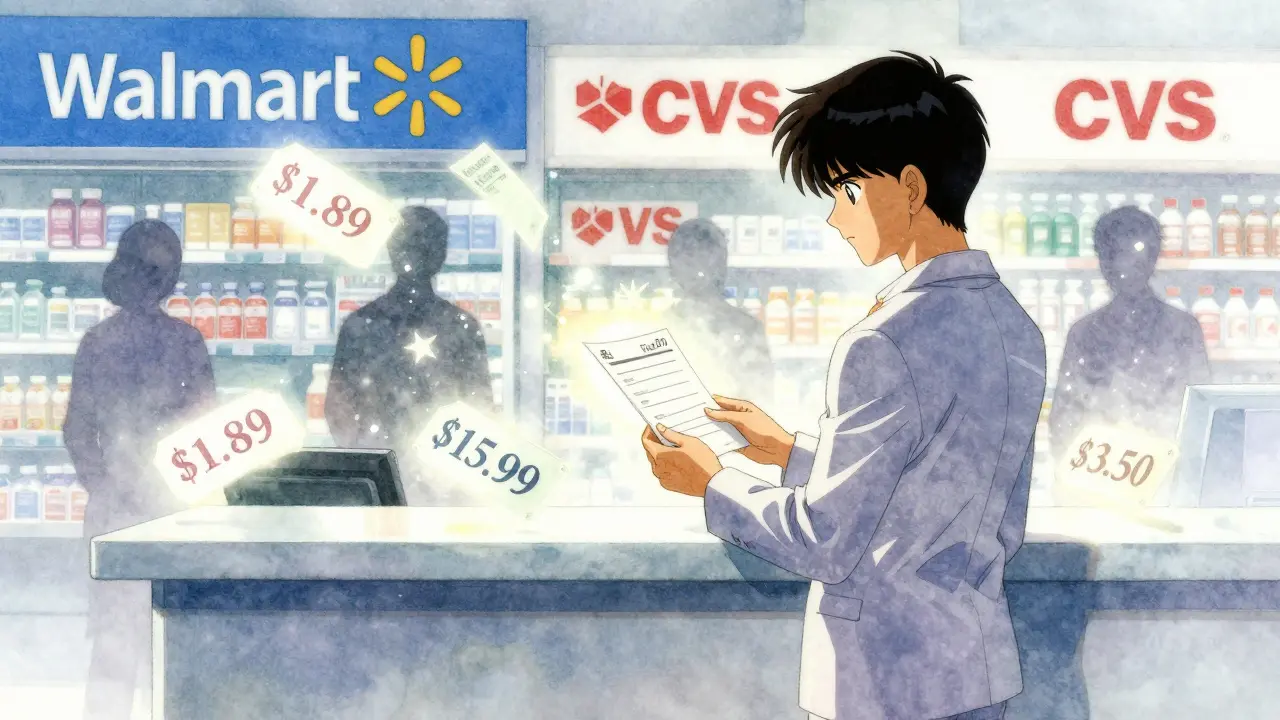
Here’s the real kicker: a generic drug like metformin might cost $1.89 at a local independent pharmacy, $15.99 at CVS, and $3.50 at Walmart - all on the same day. Why? Because big chains mark up prices to cover overhead. Independent pharmacies often run on thin margins and use low prices to bring customers in. Supermarkets like Kroger and Target have their own discount programs, sometimes offering generics for $4 or $9.
Brand-name drugs? Not as much luck. GoodRx and other discount tools rarely cut deep on brand-name drugs because manufacturers don’t offer big rebates for cash sales. But for generics? The savings can be massive.
The Tools That Save You Money
You don’t have to call every pharmacy in town. Three free apps do the work for you:
- GoodRx: The most popular. Shows prices at over 70,000 U.S. pharmacies. Users report average savings of 88% on generics.
- RxSaver: Often shows different prices than GoodRx. Worth checking side-by-side.
- WellRx: Owned by Walgreens, but still useful for comparing prices at non-Walgreens locations.
Here’s how to use them:
- Enter your medication name and dosage (e.g., “metformin 500mg”)
- Enter your ZIP code
- Compare prices across at least three pharmacies
- Download or print the coupon
- Present it at checkout - no insurance needed
Pro tip: Always ask for the cash price before showing your insurance. Sometimes, the cash price with a coupon is cheaper than your insurance copay. This happens often with high-deductible plans.
Where to Find the Best Deals
Not all pharmacies are created equal. Here’s the breakdown:
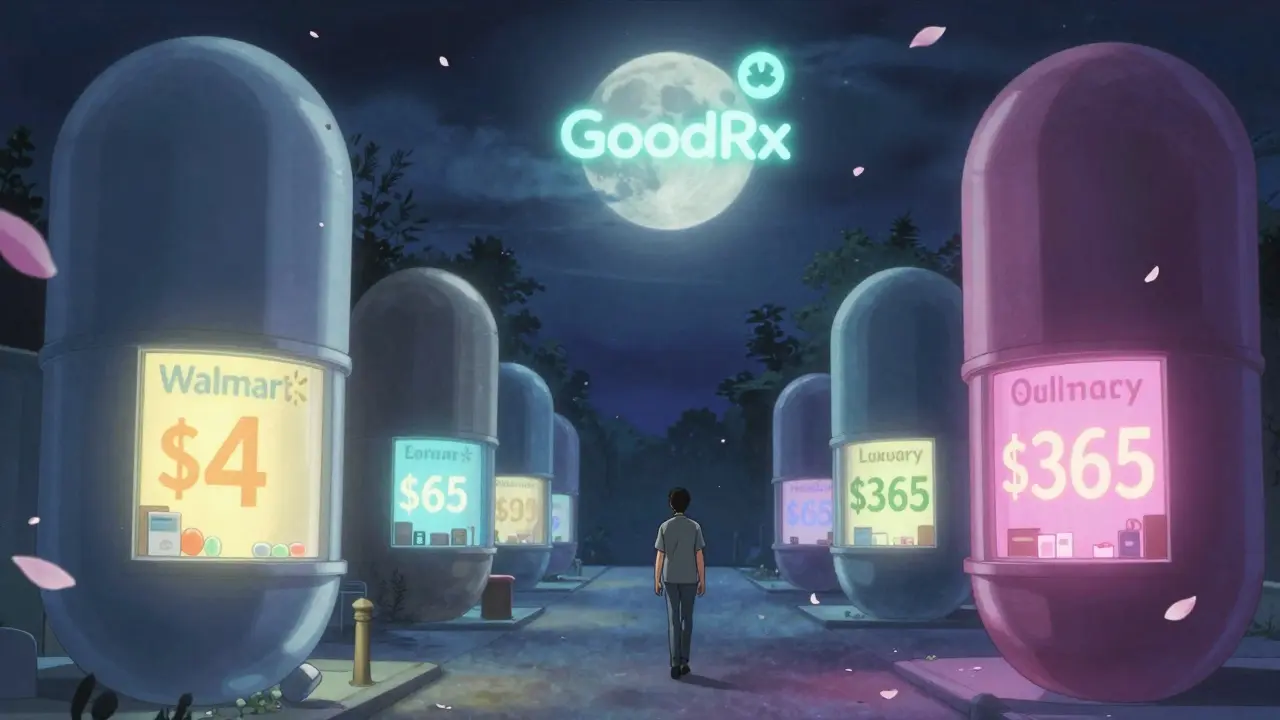
| Pharmacy Type | Undiscounted Cash Price | GoodRx-Discounted Price |
|---|---|---|
| Supermarket (e.g., Kroger, Safeway) | $52.10 | $28.17 |
| Mass Merchandiser (e.g., Walmart, Target) | $58.45 | $29.30 |
| National Chain (e.g., CVS, Walgreens) | $114.80 | $64.42 |
| Independent Pharmacy | $87.30 | $45.60 |
| Analytical Pharmacy (specialty) | $365.12 | $340.88 |
Supermarkets and mass merchandisers win for generics. Walmart’s $4/$9 program covers over 100 common drugs. Target has a similar program. Kroger offers $4 for 30-day supplies of many generics.
Independent pharmacies? They’re unpredictable. Sometimes they’re the cheapest. Sometimes they’re the most expensive. But here’s a trick: ask the pharmacist if they offer a loyalty discount. UnityPoint Health found that 38% of independents quietly offer unadvertised discounts to regulars.
Mail Order and Non-Profit Options
If you take the same meds every month, consider mail order. RXOutreach.com is a non-profit that gives qualifying patients access to generic medications at prices as low as $10 for a 90-day supply. To qualify, your household income must be at or below 300% of the federal poverty level - about $45,000 for one person in 2023. You don’t need to be uninsured. Even if you have Medicare, you can still use RXOutreach for drugs not covered by your plan.
Another option: ask your doctor about patient assistance programs. Drug makers like Pfizer, Merck, and AbbVie offer free or low-cost medications to people who meet income requirements. You can find these at pparx.org.
What About Brand-Name Drugs?
GoodRx and similar tools don’t help much with brand-name drugs. Why? Manufacturers don’t offer discounts for cash sales - they only cut deals with PBMs and insurers. But here’s what you can do:
- Ask your doctor if a generic is available. For example, atorvastatin (generic Lipitor) costs 90% less than brand-name Lipitor.
- Ask about therapeutic alternatives. Sometimes, a different drug in the same class works just as well - and costs way less.
- Check if the manufacturer has a savings card. Many brand-name drugs have coupons on their official websites.
One user in Chicago found their insulin price ranged from $98 to $345 across four pharmacies within two miles. That’s not a typo. It’s the reality.
Medicare Users: Don’t Skip This Step
If you’re on Medicare, your plan changes every year. During open enrollment (October 15 to December 7), review your plan’s formulary and preferred pharmacy network. Many Medicare Part D plans have lower copays at specific pharmacies. Switching to a preferred pharmacy can cut your costs by 15-25%.
Also, check if your plan covers mail-order prescriptions. Some plans charge less for 90-day supplies delivered to your door.
Real Stories, Real Savings
Reddit user u/MedSaver2023 paid $1.89 for metformin at a local pharmacy using GoodRx - $14 cheaper than CVS. Another user saved $112 on Synthroid at Walmart compared to what their insurance would have charged.
One HealthUnlocked forum member said GoodRx saved them nothing on their brand-name Humira - but when their doctor switched them to a generic alternative, the savings jumped to $75 per prescription.
These aren’t outliers. A 2022 Consumer Reports study found that 87% of people who compared prices saved money. The average savings? Over $50 per prescription.
Don’t Be Afraid to Ask
Pharmacists are your allies. They know which drugs are on sale. They know which suppliers offer better deals. Don’t be shy.
- Ask: “What’s your cash price for this without a coupon?”
- Ask: “Do you have a loyalty discount?”
- Ask: “Can you match a competitor’s price?”
Many pharmacies will. Especially independents. They want your business.
The Bottom Line
Shopping for the best cash price on medications isn’t complicated. It takes 10-15 minutes per prescription. But the savings? They add up fast.
For common generics - metformin, lisinopril, levothyroxine, atorvastatin - you can easily cut your cost by 70-90%. That’s hundreds of dollars a year.
Start with GoodRx. Compare with RxSaver. Check Walmart and Target. Talk to your pharmacist. If you’re on Medicare, review your plan every year. And if you qualify, use RXOutreach.
The system is rigged - but you’re not powerless. You just have to know how to play it.
Dan Mayer
March 9, 2026 AT 10:20Man i just paid $87 for my insulin at CVS and thought i was getting ripped off but now i realize i shouldve just walked into walmart like 3 blocks away lmao
Janelle Pearl
March 11, 2026 AT 08:09This hit me right in the feels. I used to skip doses because i couldn't afford the cash price until i found GoodRx. Now i take my meds like clockwork. You're not alone in this. Small steps save lives.
And yes, pharmacists? They're angels in white coats. Just ask. They want you to be well.
Neeti Rustagi
March 12, 2026 AT 09:49While the information presented is largely accurate, it is imperative to recognize that the structural inequities within pharmaceutical distribution systems are not merely logistical but deeply systemic. The reliance on third-party intermediaries such as Pharmacy Benefit Managers (PBMs) has created a market distortion wherein transparency is deliberately obfuscated. Moreover, the normalization of discount coupons as a primary mechanism for affordability suggests a failure of public policy rather than an innovation in consumer empowerment.
One must also consider the ethical implications of incentivizing price comparison across retail entities that operate under vastly different labor, tax, and supply chain structures. This approach, while pragmatically useful, risks reinforcing a consumerist model that diverts attention from the need for universal, equitable access to essential medicines.
Ray Foret Jr.
March 13, 2026 AT 21:29Samantha Fierro
March 13, 2026 AT 23:35The diligence required to navigate this system is not a feature-it is a flaw. That citizens must become amateur price analysts to access life-sustaining medication reflects a profound failure of healthcare infrastructure. While the tools cited are valuable, they are stopgaps, not solutions.
That said, the practical advice provided-particularly regarding independent pharmacies and loyalty discounts-is both nuanced and actionable. Pharmacists, as frontline healthcare providers, deserve greater institutional support to advocate for patients without requiring them to become negotiators.
Robert Bliss
March 15, 2026 AT 09:58Peter Kovac
March 17, 2026 AT 07:15Let’s be brutally honest: this entire system is a predatory charade. PBMs are not intermediaries-they are rent-seeking monopolists. The fact that GoodRx exists as a 'solution' proves that the market has been corrupted beyond repair. The $1.89 metformin? That’s what the drug actually costs to produce. The $114.80 at CVS? That’s the profit margin for shareholders.
And let’s not forget: the $4 program at Walmart? It’s a loss leader. They make money on your groceries, not your prescriptions. You’re not saving money-you’re being groomed for cross-selling.
APRIL HARRINGTON
March 17, 2026 AT 11:55Leon Hallal
March 18, 2026 AT 02:23You think this is bad? Wait till you find out how PBMs collude with drug manufacturers to keep prices high while pretending to negotiate discounts. The coupons? They’re designed to make you feel smart while the real profits stay hidden. I’ve seen spreadsheets. It’s worse than you think.
And don’t get me started on how they target low-income communities with high-markup generics. This isn’t a system-it’s a trap.
Judith Manzano
March 19, 2026 AT 01:36This was so helpful! I never thought to ask if my independent pharmacy had a loyalty discount. I just did it today and saved $22 on my metformin. I felt so awkward asking but the pharmacist smiled and said, 'We’ve been waiting for someone to ask.'
It made me realize how much we’re taught to suffer in silence about healthcare costs. Thank you for normalizing the conversation.
rafeq khlo
March 20, 2026 AT 23:02Morgan Dodgen
March 21, 2026 AT 14:31Let’s cut through the noise: GoodRx isn’t saving you money-it’s extracting data, profiling your health habits, and selling them to PBMs who then adjust pricing algorithms to maximize profit margins on your next refill. The 'discount' is a bait-and-switch engineered to keep you compliant while the real cost is your privacy and autonomy.
And let’s not forget: the $4 program? That’s subsidized by your grocery purchases. You’re not getting a deal-you’re funding corporate expansion. Wake up.
Philip Mattawashish
March 22, 2026 AT 15:41It’s not about shopping around. It’s about recognizing that the entire pharmaceutical industry is a feudal system where patients are serfs and PBMs are the lords. The fact that you need to beg, compare, and hunt for discounts proves that medicine has been commodified into a luxury.
And you call this empowerment? No. This is survival. And survival shouldn’t require a spreadsheet.
Someone should’ve taken this to Congress years ago. Instead, we’re left to Google prices like we’re haggling at a flea market for our own heartbeat.