

Quick Wins for Medication Safety
- Use a weekly pill organizer to see gaps in doses instantly.
- Set up smartphone reminders or a dedicated app to track timing.
- Assign one specific person to administer meds in multi-caregiver homes.
- Always use the dosing syringe provided with liquid meds-never a kitchen spoon.
- Keep a master list of all active ingredients to avoid "hidden" duplicates.
The Danger of Hidden Duplicates
One of the sneakiest ways people double-dose is by taking two different products that contain the same active ingredient. For example, you might take a branded pain reliever and a multi-symptom cold medicine, not realizing both contain acetaminophen. This is a form of unintentional double-dosing that can put a massive strain on your liver.
To stop this, you need a comprehensive medication list. This shouldn't just be your prescriptions. Include over-the-counter (OTC) drugs, vitamins, and supplements. A study from EssexCare Pharmacy found that about 32% of double-dosing incidents involved these overlapping ingredients. When you buy a new OTC product, check the "Active Ingredients" section and compare it to your current list. If you're unsure, a pharmacist is your best resource for a quick safety check.
Low-Tech Visual Hacks for Daily Tracking
You don't need a PhD in computer science to track your meds. Some of the most effective methods are the simplest. For people who only take one pill a day, the "bottle flip" method is a lifesaver. Simply turn your pill bottle upside down after you take your dose. If the bottle is right-side up, you know you haven't taken it yet. If it's upside down, you're set for the day.
For those with more complex needs, pill organizers are the gold standard. These plastic containers with dated compartments allow you to see at a glance if a dose is missing. According to a caregiver survey by WesleyLife, these tools can reduce errors by about 35%. If you take meds at different times, look for organizers labeled AM, Noon, PM, and Bedtime. This prevents the common mistake of taking an evening dose twice because you forgot the morning dose was already handled.
Digital Tools and Smart Reminders
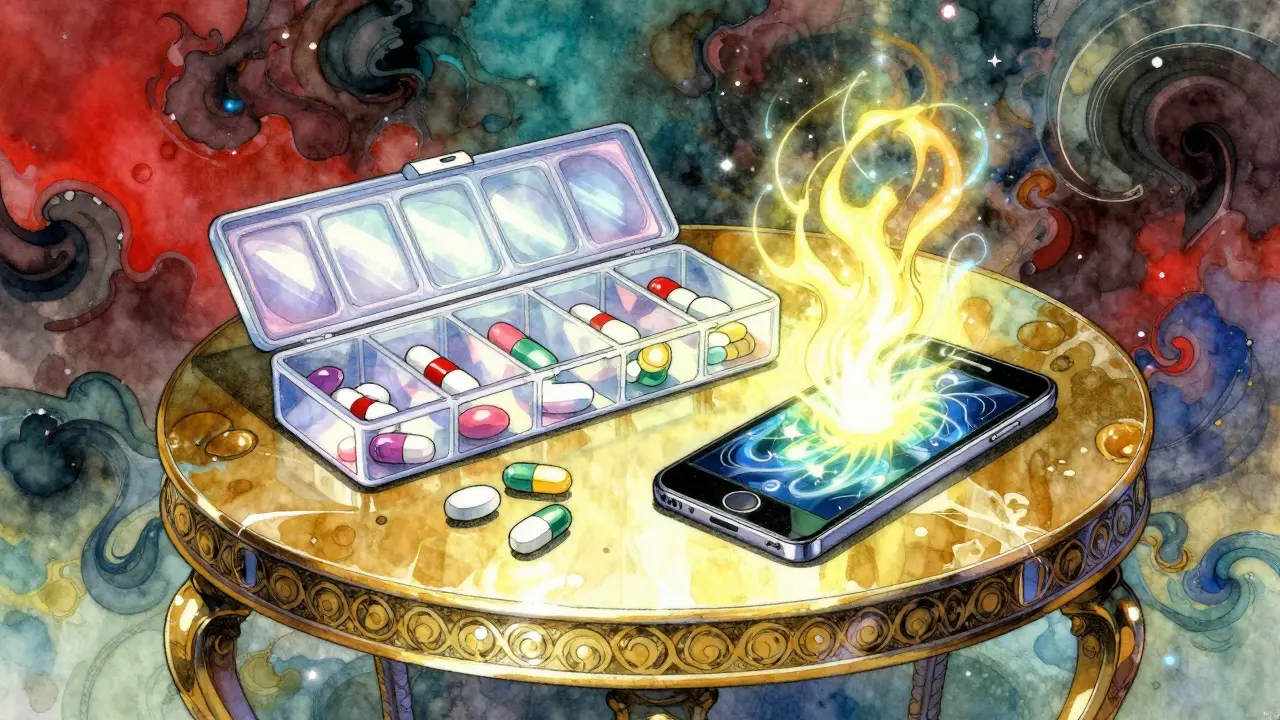
If you find yourself staring at a pillbox and still feeling anxious, it's time to go digital. Smartphone apps have changed the game for medication adherence. Medisafe is a prominent example, with studies showing an 87% improvement in adherence rates. These apps don't just beep at you; they often require you to "check off" the dose, creating a digital paper trail.
For high-risk situations-like patients taking blood thinners (e.g., Warfarin) where an extra dose could be fatal-combining a digital app with a physical journal is the safest bet. The synergy is powerful: while pill organizers alone reduce errors by 35%, adding digital reminders bumps that effectiveness up to 62%. For those who need maximum security, smart pill dispensers that lock automatically after a dose is dispensed can reduce double-dosing incidents by as much as 76%.
| Method | Best For... | Pros | Cons |
|---|---|---|---|
| Bottle Flipping | Single daily dose | Zero cost, instant setup | Easy to forget to flip back |
| Pill Organizers | Multi-dose regimens | Visual confirmation of gaps | Requires weekly filling time |
| Reminder Apps | Forgetful users/Tech-savvy | Active alerts and logs | Requires smartphone battery |
| Smart Dispensers | High-risk/Cognitive decline | Prevents physical access | Expensive, bulky |
Preventing Double-Dosing in Children
Managing medications for kids is a different beast entirely. The biggest risk here is "shared responsibility." When two parents or a parent and a grandparent are both helping, it's incredibly easy for a child to get a dose from one person and then another from the second person who didn't know it happened. St. Louis Children's Hospital notes that assigning the task to just one person can slash double-dosing incidents by nearly 50%.
Another critical area is liquid measurement. Many parents rely on kitchen spoons, but these are wildly inaccurate. Research shows that household teaspoons can vary from 2.5mL to 7.3mL-a difference that can lead to an accidental overdose in a small child. Only use the oral syringe or dosing cup that comes with the medicine. Also, be wary of the "refusal loop": a child refuses a dose, the parent gives up, and then the child accepts the medicine from a different caregiver an hour later. A shared medicine schedule or a simple whiteboard on the fridge can stop this from happening.

Building a Fail-Safe Routine
The best way to stop double-dosing isn't through better tools, but better habits. The goal is to "anchor" your medication to an existing habit. This is called habit stacking. Instead of trying to remember a random time, link your meds to something you never forget, like brushing your teeth, brewing your first pot of coffee, or feeding the dog. Data shows that nearly 78% of people who successfully stick to their meds use this routine-based approach.
Be especially careful during "trigger events." Travel, daylight saving time changes, and holiday visits are the top three scenarios where double-dosing happens. When you travel, keep your pill organizer in your carry-on, not your checked luggage, to avoid the panic of "Did I take it before I left?" and then taking it again upon arrival.
What to Do if a Double-Dose Occurs
Despite your best efforts, mistakes happen. If you realize you've taken too much, don't wait for symptoms to appear. Some medications have a delayed effect, and by the time you feel sick, the window for easy intervention may have closed. The most important step is to contact professional help immediately. The National Poison Control Center is available 24/7 at 1-800-222-1222. Be ready to tell them the exact medication, the dosage, and when the doses were taken.
Can I use a kitchen spoon to measure liquid medicine?
No. Kitchen spoons are not standardized and can vary in volume by 20-65%. This inconsistency can lead to significant under-dosing or dangerous double-dosing. Always use a medical-grade oral syringe or the measuring cup provided with the medication.
What is the most effective way to prevent double-dosing for seniors?
The most effective approach is a multi-layered strategy. Combining a physical pill organizer (which provides visual confirmation) with a digital reminder app (which provide active alerts) increases error prevention effectiveness to about 62%.
How do I identify if two different medications have the same active ingredient?
Check the "Drug Facts" label on the back of the packaging. Look for the "Active Ingredients" section. If you see the same chemical name (e.g., Acetaminophen) on two different products, you are at risk of double-dosing. Consulting a pharmacist is the safest way to verify this.
Why is it better to have one person handle a child's medication?
Having a single designated "medication giver" eliminates communication gaps between caregivers. In households with multiple adults, this simple change has been shown to reduce double-dosing errors by nearly 50%.
What should I do if I'm not sure if I took my medication?
Do not automatically take another dose. Check your tracking system (pillbox, app, or journal). If you are still unsure, contact your pharmacist or doctor for guidance based on the specific medication's half-life and risks.