

Every year in the U.S., more than 1.5 million people are harmed by medication errors. Many of these mistakes happen because someone didn’t double-check the name, strength, or dosage form of a drug. It sounds simple, but in the rush of a hospital shift, a busy pharmacy, or even at home when managing prescriptions, these small details get missed - and the consequences can be deadly.
Why Checking Medication Details Matters
Medication errors aren’t rare accidents. They’re preventable failures in basic verification. The Institute of Medicine found that roughly 7,000 people die each year in U.S. hospitals because of mistakes like giving the wrong dose, confusing one drug for another, or using the wrong form - like giving an oral pill when the patient needs a liquid.
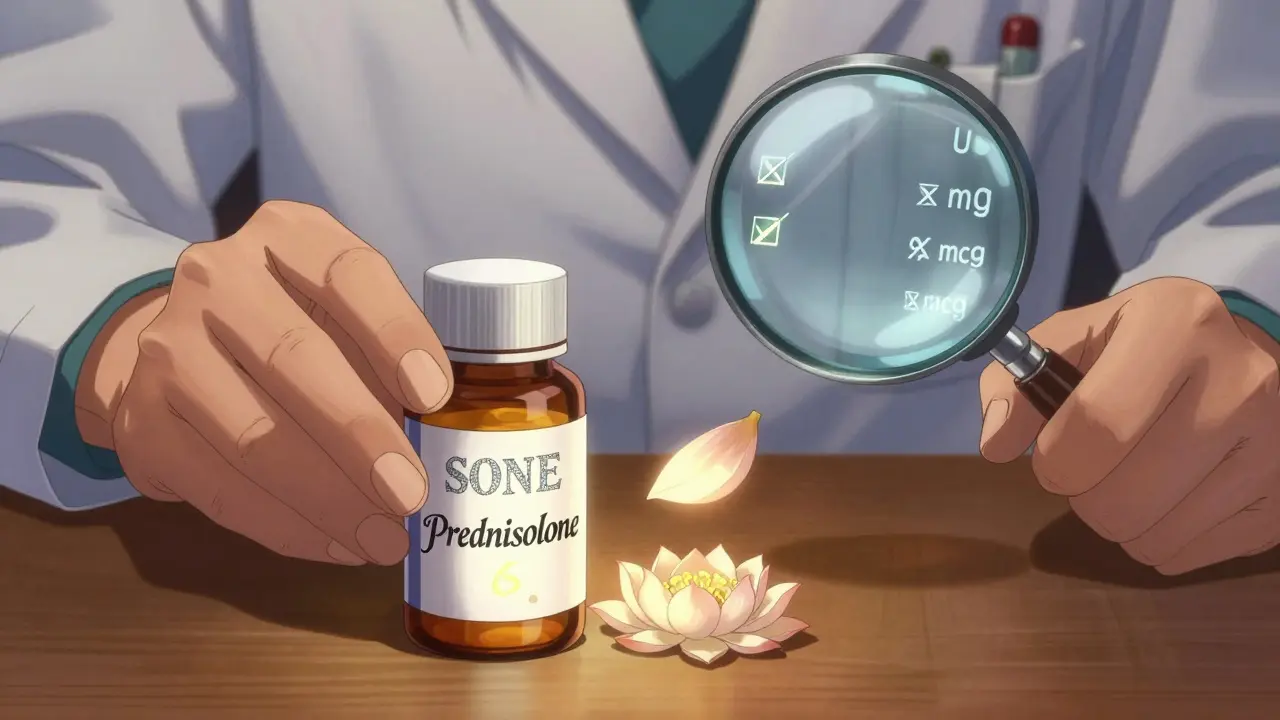
Look-alike, sound-alike drugs are a huge problem. Think of prednisone and prednisolone. They sound almost identical. Without clear labeling, a nurse might grab the wrong one. Or take heparin: one vial is 5,000 units/mL, another is 50 units/mL. Mistake one for the other, and you’re giving a 100-fold overdose. That’s not hypothetical. Nurses on AllNurses.com have shared real stories where this exact mix-up was caught just in time.
The fix isn’t fancy technology. It’s discipline. It’s training. It’s making sure every single time you handle a medication, you stop, look, and confirm - not once, but three times.
The Three Critical Points for Verification
Professional guidelines from the American Society of Health-System Pharmacists (ASHP) and the Institute for Safe Medication Practices (ISMP) agree: verification must happen at three key moments.
- When you receive the order - whether it’s handwritten, electronic, or verbal. Check if the drug name is complete, the strength has units (like mg, mcg, or units), and the dosage form is specified (tablet, capsule, injection, cream, etc.). If any piece is missing, don’t proceed. Ask for clarification.
- When you prepare the medication - this is where you compare the prescription to the actual drug in your hand. Read the label on the bottle, vial, or blister pack. Does the name match? Is the strength the same? Is the form correct? Don’t rely on memory. Don’t assume. Read it out loud.
- Just before you give it to the patient - confirm the patient’s identity, then repeat the medication name, strength, and form aloud. This is called the “read-back” method. It’s not optional. It’s the last safety net.
A Mayo Clinic case study showed that using this three-step check for high-risk drugs like insulin, heparin, and opioids cut errors by 94% over 18 months. That’s not luck. That’s process.
What to Look For: Names, Strengths, and Forms
Let’s break down each part of the medication label - what you need to see, what you should question, and what you must never ignore.
Drug Name
Always use the full generic name. Avoid abbreviations. “MS” could mean morphine sulfate - or magnesium sulfate. “U” for units looks like a zero. “mcg” is correct; “μg” is confusing. The FDA and ISMP banned these abbreviations for a reason.
Look for “Tall Man” lettering - where different parts of similar drug names are capitalized to make them easier to distinguish. For example:
- predniSONE vs. predniSOLONE
- HYDROmorphone vs. HYDROcodone
- DAunorubicin vs. DOXOrubicin
This simple formatting trick reduced confusion errors by 76% in hospitals that adopted it.
Strength
Strength isn’t just a number. It’s a number with a unit. Always check:
- Is it mg, mcg, or units?
- Is there a space between the number and unit? “10mg” is dangerous. “10 mg” is safe. ISMP found this spacing prevents 12% of errors.
- Is there a leading zero? “.5 mg” is risky. “0.5 mg” is clear. Missing the zero can make someone read it as 5 mg.
For injectables, avoid ratios. Don’t write “epinephrine 1:10,000.” Write “epinephrine 0.1 mg/mL.” Between 2010 and 2015, over 200 errors happened because people misread ratios. The fix? Use concentration units instead.
Dosage Form
This is often the most overlooked part. A pill isn’t the same as a liquid. A patch isn’t the same as an injection.
Common errors:
- Giving an oral tablet to a patient who can’t swallow - and they choke.
- Using a topical cream as if it’s an oral suspension - causing poisoning.
- Administering a sustained-release capsule by opening it - destroying the time-release mechanism.
Always verify: tablet, capsule, liquid, injection, patch, inhaler, suppository? If the form isn’t written on the order, ask. If it’s not printed on the label, don’t give it.
How Technology Helps - and Hurts
Electronic health records (EHRs) and barcode scanning have cut errors dramatically. Hospitals using barcode systems reduced dispensing mistakes by 83%. Systems like Epic and Cerner now cross-check drug names against 18,000+ entries and auto-flag look-alike matches.
But tech isn’t perfect. A 2020 study from The Joint Commission found that 18% of errors happened because clinicians trusted the system too much. They saw a green light on the screen and skipped the manual check. This is called “automation bias.”
And not all systems are equal. Community pharmacies have far lower adoption rates than hospitals. One survey found only 27% of pharmacies use barcode scanning. That means more reliance on human memory - and more risk.
Even the best system can’t fix an incomplete order. A First DataBank study found that 87% of name confusion errors happened because the prescription was missing strength or form details.
What You Can Do - Even If You’re Not a Professional
You don’t have to be a nurse or pharmacist to prevent a medication error. If you’re managing prescriptions for yourself or someone else:
- Always read the label on the bottle before taking a pill.
- Compare it to the prescription you got from the doctor.
- Ask your pharmacist: “Is this the same as what the doctor ordered?”
- If the pill looks different - color, shape, markings - ask why.
- Never assume a generic version is identical in form or strength. Some generics use different fillers or release mechanisms.
Keep a written list of all your medications - name, strength, form, and why you take it. Bring it to every appointment. Use it to cross-check new prescriptions.
Common Pitfalls and How to Avoid Them
Here are the top mistakes - and how to stop them before they happen:
- Misreading “U” for “0” - Always write “units,” never “U.”
- Confusing mcg with mg - 100 mcg is not 100 mg. That’s a 100-fold difference. Always spell out “microgram.”
- Skipping the form - If the order says “insulin,” but doesn’t say “injection” or “pen,” ask.
- Assuming dosage is the same - A 10 mg tablet is not the same as 10 mg of liquid. Concentration matters.
- Ignoring time-sensitive forms - Extended-release pills must be swallowed whole. Crushing them can cause overdose.
One nurse on Reddit shared how she caught a 10-fold insulin error because she noticed the vial said “U-100” but the order said “U-500.” She paused. She called the pharmacy. She saved a life.

Training and Culture Make the Difference
Hospitals that train staff for just 4 hours on verification, then do 30-minute refreshers every quarter, cut errors by 63%. That’s not magic. That’s repetition.
But training only works if the culture supports it. If nurses feel rushed, they’ll skip steps. If pharmacists are overworked, mistakes creep in. The American Nurses Foundation found that 78% of nurses admitted to skipping verification during peak hours.
The fix? Systems that force compliance. The Joint Commission requires that electronic orders cannot be submitted without complete drug name, strength, form, route, and frequency. That’s not optional. It’s built into the software.
And it’s working. States that require mandatory verification for high-risk drugs have 29% fewer errors than those that don’t.
What’s Next for Medication Safety
The FDA is moving toward digital labeling with machine-readable codes that include RxNorm-standardized names, precise strength values, and dosage form codes. By 2026, new prescriptions may come with QR codes that link directly to verified drug data.
AI is also being tested. Google Health’s pilot system used image recognition to scan medication labels and spot mismatches with 99.2% accuracy. But until the FDA sets validation standards, it won’t be widely used.
The future isn’t about replacing humans. It’s about giving humans better tools - and reinforcing the discipline to use them.
Final Reminder: Your Eyes Are Your Best Tool
No app, no scanner, no alert system is as reliable as a person who stops, reads, and confirms. Medication safety isn’t about technology. It’s about attention.
Every time you pick up a pill bottle, read the label like it’s the first time. Compare it to the order. Ask questions. Don’t rush. Don’t assume. Don’t ignore the form, the strength, or the name.
Because in medication safety, the smallest detail - a missing space, a forgotten unit, a misread form - can mean the difference between healing and harm.
Aisling Maguire
March 2, 2026 AT 00:59Also, why do people still write 'mcg' instead of 'microgram'? It’s 2024. We got autocorrect.
Gigi Valdez
March 3, 2026 AT 13:08Sneha Mahapatra
March 3, 2026 AT 17:24Angel Wolfe
March 4, 2026 AT 07:50Sophia Rafiq
March 4, 2026 AT 22:15Eimear Gilroy
March 6, 2026 AT 01:38Ajay Krishna
March 6, 2026 AT 19:43Justin Ransburg
March 7, 2026 AT 06:18Brandon Vasquez
March 7, 2026 AT 13:54Vikas Meshram
March 8, 2026 AT 05:40Ben Estella
March 8, 2026 AT 07:23Jimmy Quilty
March 9, 2026 AT 06:11Miranda Anderson
March 9, 2026 AT 23:54