
Splitting or crushing pills might seem like a simple fix-maybe you’re trying to save money, make it easier to swallow, or adjust a dose. But if you’re not doing it right, you could be exposing yourself or someone else to serious risks. Cross-contamination, uneven doses, and chemical exposure aren’t just theoretical dangers. They’re real, documented problems that have led to hospitalizations and even deaths. The good news? With the right tools and steps, you can avoid almost all of them.
Why Contamination Happens
Most people don’t realize that pills aren’t all the same. A regular tablet you can split with your fingers might look like a sustained-release capsule, but it’s not. The FDA estimates that 97.8% of extended-release, enteric-coated, or hazardous drugs should never be crushed or split. Why? Because breaking them can destroy how they work. A time-release pill crushed into powder might dump its entire dose all at once. That’s dangerous. And if you’re crushing chemo drugs like cyclophosphamide without a closed system, you’re inhaling or touching toxic particles. Studies show residue levels on gloves after improper crushing can reach 4.7 ng/cm²-enough to cause harm over time.Even if you’re just splitting a regular tablet, contamination can happen if you use the same splitter for multiple medications. One study found that 17.8% more contamination occurred when shared equipment wasn’t cleaned between uses. Imagine splitting warfarin for one person, then using the same tool for blood pressure pills. Traces of the blood thinner can linger and cause dangerous interactions. This isn’t speculation. In 2023, a care center had 14 residents affected by warfarin cross-contamination because staff reused splitters.
What You Should Never Split or Crush
Not all pills are created equal. Some are designed to release slowly, protect the stomach, or contain dangerous chemicals. Crushing or splitting these can be life-threatening. Here’s what to avoid:- Extended-release (ER) or long-acting pills (often marked with XL, XR, SR, or CD). Crushing these releases the full dose immediately.
- Enteric-coated tablets (usually with a shiny outer layer). These are meant to dissolve in the intestine, not the stomach. Breaking them can cause stomach upset or reduce effectiveness.
- Hazardous drugs (HDs) like chemotherapy agents, antivirals, or hormone therapies. These can aerosolize and stick to skin, surfaces, or clothing.
- Sublingual or buccal tablets meant to dissolve under the tongue or in the cheek. Crushing them ruins their absorption.
- Capsules with beads or pellets inside. Pouring them out or crushing them destroys the delivery system.
If you’re unsure, check the label. If it says “Do Not Crush” or “Do Not Split,” don’t do it. If you can’t find that info, call your pharmacist. They’re trained to know which medications are safe-and which aren’t.
The Right Tools Make All the Difference
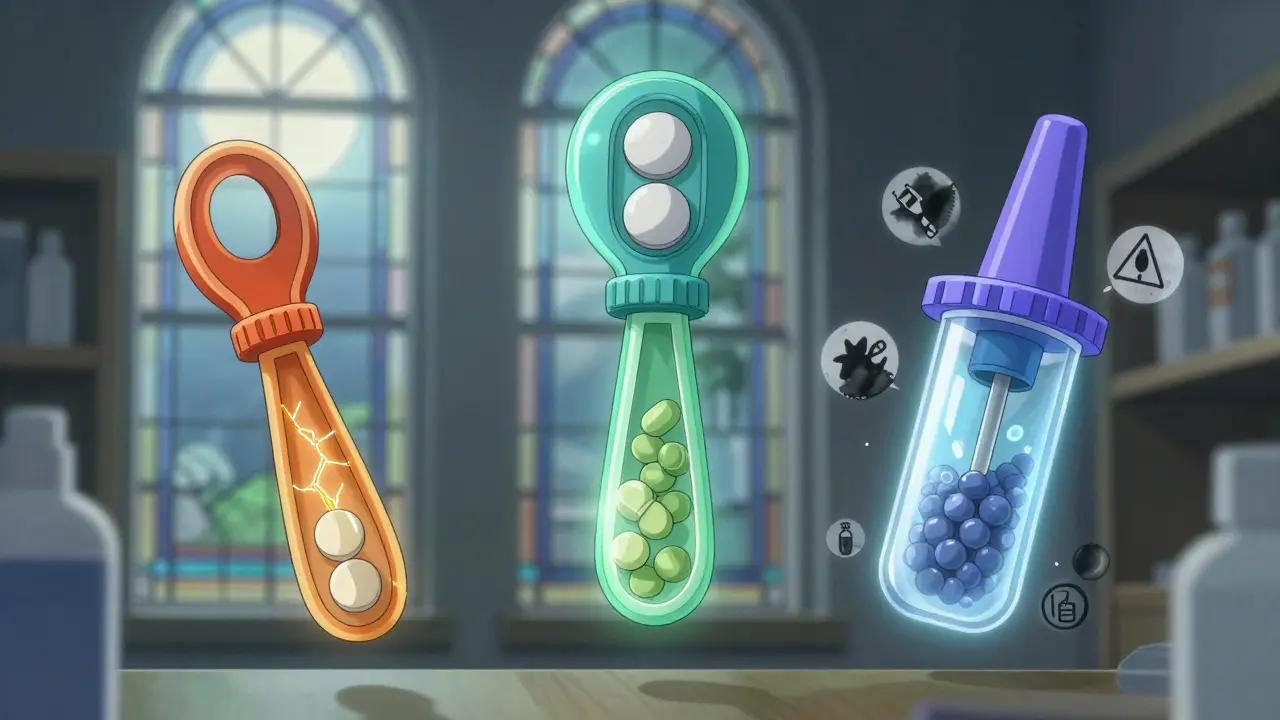
You wouldn’t use a butter knife to cut a steak. Don’t use scissors or a knife to split a pill. The tools matter. A proper pill splitter has a v-shaped holder and a retractable stainless steel blade with a 0.05mm tolerance. This ensures even division. Studies show that using a dedicated splitter gives you 92.4% dose accuracy. Scissors? Only 63.7%.For crushing, don’t use a mortar and pestle or a coffee grinder. Use a closed-system pill crusher like the Silent Knight. These devices trap all particles inside a sealed container. Open crushing releases fine dust into the air. NIOSH testing found that closed-system crushers contain 99.8% of particulate matter. Standard open crushers? Only 72.1%. That’s a massive difference when you’re dealing with hazardous drugs.
Also, get a splitter that’s labeled for single-patient use. Many care homes now assign each resident their own splitter, color-coded and stored separately. This cuts contamination risk by over 60%.
Step-by-Step: How to Split or Crush Safely
If you’ve confirmed the pill can be split or crushed, follow this exact process:- Wash your hands with soap and water for at least 20 seconds. Dry them completely.
- Put on clean gloves (nitrile or latex). This protects you from hazardous residues and keeps the pill clean.
- Disinfect your equipment. Wipe the splitter or crusher with a 70% isopropyl alcohol wipe. Let it air dry. Don’t skip this-even if it looks clean.
- Place the pill in the device. Align it with the score mark. Don’t guess. If the tablet has a visible line, center it exactly.
- Split or crush once. Do it in one clean motion. Never try to re-split a half or crush again. That increases error rates.
- Administer immediately. Don’t store split or crushed pills. Exposure to air, light, or moisture can degrade the medication. If you must store it (only if approved by your pharmacist), use a sealed, labeled container and keep it in a cool, dry place for no more than 24 hours.
- Clean the device again. Wipe it with alcohol. Let it dry. Store it separately from other equipment.
Pro tip: If you’re splitting a pill for someone else, never use the same device for multiple people. Even if you clean it, microscopic residues can remain. That’s why 87.3% of hospitals now do splitting in a centralized pharmacy-not on the nursing floor.
What About Pre-Splitting? Don’t Do It
Some people think, “I’ll split all my pills at once and store them.” That’s a mistake. The FDA explicitly warns against this. Once you split a tablet, it’s exposed. Moisture, air, and light can break down the active ingredient. A 2021 study found that split tablets stored for more than 24 hours lost up to 15% of their potency. That’s not a small loss-it could mean your blood pressure meds aren’t working.Even if you’re using airtight containers, there’s no guarantee. The FDA doesn’t require manufacturers to test stability after splitting. So unless your pharmacist has verified it’s safe for your specific drug, split one pill at a time, right before you take it.

Who’s at Risk? And Why It Matters
This isn’t just about older adults. About 23% of people in long-term care facilities need split doses. But it’s also happening at home. A 2023 survey found 41.7% of family caregivers didn’t know sharing pill splitters could cause contamination. And in 63.2% of care homes, staff admitted to using scissors because they didn’t have proper splitters.Pharmacists can help. One study showed pharmacist-led education cut splitting errors by 58.3%. If you’re unsure, ask. Your pharmacist can tell you if your pill can be split, recommend a safe device, and even pre-split pills for you in a controlled environment.
What’s Changing in 2026
Regulations are tightening. By the end of 2026, the FDA will require all scored tablets to be tested and labeled for splitability. That means clearer instructions on packaging. Also, the Joint Commission now flags improper pill splitting as a top 10 safety issue during inspections. Facilities that don’t train staff or use proper equipment could lose funding.Smart devices are emerging too. New splitters like the Med-Engage system have built-in sensors that verify the dose was split correctly and log it in the patient’s record. Early trials show a 47.2% drop in errors. These won’t be everywhere yet, but they’re coming.
Final Checklist: Your Safety Routine
Before you split or crush any pill, ask yourself:- Is this pill labeled “Do Not Crush” or “Do Not Split”? If yes, stop.
- Do I have a dedicated, clean pill splitter or closed-system crusher?
- Did I wash my hands and put on gloves?
- Did I disinfect the equipment with alcohol before and after?
- Am I splitting one pill at a time-not the whole bottle?
- Will I give the split dose right away?
If you answered no to any of these, don’t proceed. Talk to your pharmacist. There’s no shame in asking. A few minutes of caution now can prevent a hospital visit later.
Can I use scissors to split pills if I don’t have a splitter?
No. Scissors and knives create uneven splits and leave behind residue. Studies show only 63.7% dose accuracy with scissors, compared to 92.4% with a proper pill splitter. You’re also more likely to contaminate the pill or your hands. If you can’t afford a splitter, ask your pharmacy-they often give them out for free.
Is it safe to crush pills for people who have trouble swallowing?
Only if the pill is specifically approved for crushing. Many medications-especially extended-release, enteric-coated, or hazardous drugs-should never be crushed. Always check with your pharmacist first. If crushing is necessary, use a closed-system crusher to prevent exposure to airborne particles.
Can I store split pills for later use?
The FDA advises against it. Once a tablet is split, it begins to degrade. Exposure to air, light, or moisture can reduce its potency. If you must store it, use a sealed container and keep it for no more than 24 hours. But the safest practice is to split one pill right before taking it.
How do I clean a pill splitter between uses?
Wipe all surfaces with a 70% isopropyl alcohol wipe. Let it air dry completely. Never rinse with water-it can leave moisture that promotes mold or degradation. If you’re using the splitter for multiple people, assign one per person and label it. Never share without thorough cleaning.
What should I do if I accidentally crush a pill I wasn’t supposed to?
Stop using the medication immediately. Call your pharmacist or doctor. Depending on the drug, you may need to skip a dose or get a replacement. If it was a hazardous drug, wash your hands and any surfaces it touched with soap and water. Report the incident-this helps improve safety practices.
Caroline Bonner
March 23, 2026 AT 09:53Okay, I just read this through twice, and I have to say-I’m blown away by how much I didn’t know. I’ve been splitting my mom’s pills with a butter knife for years because it ‘seemed fine.’ I didn’t even realize that 17.8% more contamination happens when you reuse splitters! I mean, come on-how many of us are doing this without even thinking? I’m ordering a dedicated, color-coded splitter today. And I’m going to disinfect it with alcohol every single time-no excuses. Also, I never knew the FDA was pushing for splitability labeling by 2026. That’s huge. I’m telling all my friends in the caregiving group. This isn’t just about pills-it’s about dignity, safety, and not accidentally poisoning someone you love. Thank you for writing this. Seriously. I’m saving this page.
Chris Crosson
March 24, 2026 AT 11:06Wait-so scissors give you only 63.7% accuracy? That’s wild. I’ve been using mine for years. But if a proper splitter gives 92.4%, why aren’t these things standard in every pharmacy? Why do I have to beg for one? My mom’s on warfarin. I’d rather risk a bad split than a bad reaction. Also-closed-system crushers? I didn’t even know those existed. I’m ordering one. And yeah, I’m calling my pharmacist tomorrow. No more guessing.
Linda Foster
March 25, 2026 AT 06:23Thank you for this comprehensive and meticulously referenced guide. The clinical data presented is both compelling and necessary for public health literacy. I will be sharing this with my institution’s medication safety committee. The statistical evidence regarding cross-contamination, particularly the 4.7 ng/cm² residue levels, warrants immediate policy review. Furthermore, the recommendation for centralized pharmacy splitting aligns with best practices in patient safety management. I commend the clarity of the step-by-step protocol and the emphasis on pre-splitting avoidance. This is an exemplary model of evidence-based patient education.
Rama Rish
March 26, 2026 AT 10:50omg this is so important!! i never knew crushin chemo pills was dangerous. my aunt does it all the time. im gonna send her this right now. also-get a splitter, not scissors. simple. no joke.
Kevin Siewe
March 27, 2026 AT 00:18I’ve worked in home health for 12 years. This article says everything I’ve been trying to teach nurses and families. The real tragedy? Most people don’t know they’re at risk. I’ve seen cases where a split tablet led to a bleed. It’s not dramatic-it’s quiet. And it’s preventable. If you’re caring for someone, ask your pharmacist. Don’t assume. Don’t improvise. The tools are cheap. The consequences aren’t. I’ve handed out over 200 splitters to families. They’re usually free. Just ask.
Chris Farley
March 27, 2026 AT 20:41So the FDA says you can’t crush pills? Wow. What a nanny state. I’ve been crushing my blood pressure meds for decades. I’m 72, not a lab rat. If I want to open a capsule and mix it with applesauce, that’s my choice. Who are they to tell me how to take my medicine? This is just another way they control us. Next they’ll ban chewing aspirin. I bet the pharmaceutical companies are behind this-they want you to buy whole pills so they can charge more. This is corporate propaganda disguised as safety.
Sean Bechtelheimer
March 28, 2026 AT 01:48They’re lying. This whole thing is a scam. Pills don’t even have coatings. The government and Big Pharma made up contamination to sell you $80 splitters. I’ve been crushing pills with my teeth since ’99. No one’s died. I’ve got 14 kids and 3 grandkids-all healthy. You’re being manipulated. Also, I saw a guy on YouTube who said the ‘closed system’ is just a way to make you buy more junk. 🤡
Seth Eugenne
March 28, 2026 AT 09:05This is so helpful. I’ve been splitting my dad’s pills with a knife because I didn’t know better. 😔 I’m so glad I read this. I just ordered a splitter and some nitrile gloves. Also, I’m going to wipe everything with alcohol now. I never thought about how light and air affect the medicine. This is the kind of info that saves lives. Thank you for taking the time to write this. 🙏
rebecca klady
March 30, 2026 AT 00:09Wait, so I can’t store split pills? I’ve been doing that for months. I split all my meds on Sunday and put them in a little box. I guess I’ve been risking my health… I’m gonna stop. Thanks for the heads up. I’m calling my pharmacist tomorrow.
Brandon Shatley
March 30, 2026 AT 09:28so i just read this and wow. i never even thought about the fact that splitters could be dirty. i used my sister’s for my mom’s pills. i feel bad. i’m gonna get my own. also-70% alcohol? i didn’t know that. i was just rinsing with water. i’ll fix it. thanks for the info. really useful.
Blessing Ogboso
March 31, 2026 AT 20:33This is one of the most thoughtful, well-researched pieces I’ve read in a long time. Coming from Nigeria, where pill-splitting is common due to cost and access issues, I’ve seen people use razor blades, knives, even rocks to divide tablets. We don’t have access to splitters or alcohol wipes. But now, I understand why this isn’t just about convenience-it’s about survival. I’m going to start a community awareness campaign in my neighborhood. I’ll translate this into Pidgin English and Yoruba. I’ll show people how to make a DIY splitter from a plastic bottle and a ruler. We can’t wait for the FDA. We have to act now. Thank you for giving us the science. We’ll use it wisely.