
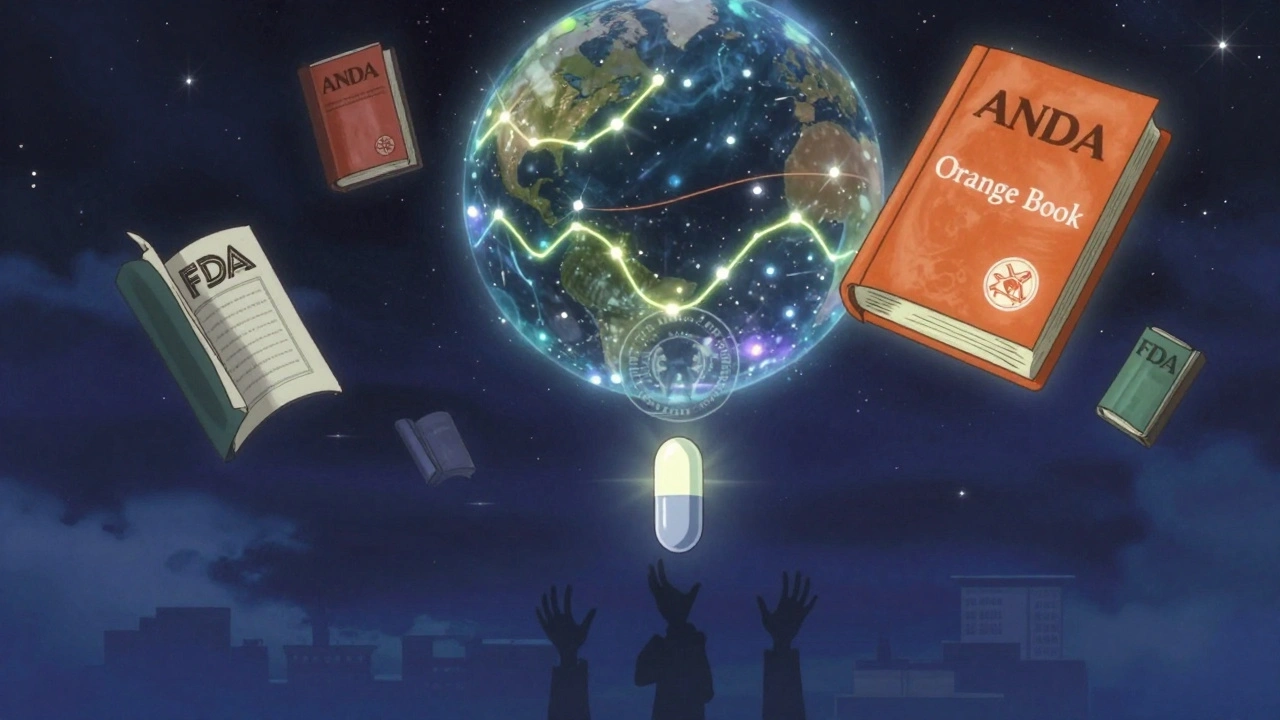
The Hatch-Waxman Act didn’t just change how drugs are approved in the U.S.-it rewrote the rules of who gets access to medicine and at what price. Before 1984, if you wanted to make a generic version of a brand-name drug, you had to start from scratch. That meant running your own clinical trials, even though the original drug had already been proven safe and effective. It cost around $2.6 million in today’s dollars and took years. Only a handful of companies even tried. Then came the Drug Price Competition and Patent Term Restoration Act of 1984-better known as the Hatch-Waxman Act-and everything changed.
How the Hatch-Waxman Act Broke the Generic Drug Logjam
The Act created a shortcut: the Abbreviated New Drug Application, or ANDA. Instead of repeating clinical trials, generic manufacturers could prove their drug was the same as the brand-name version-same active ingredient, same strength, same pill form, same way it’s taken. All they had to show was bioequivalence: that their version delivered the same amount of medicine into the bloodstream at the same rate. The FDA set the bar at 80-125% similarity in absorption, measured by Cmax and AUC. That’s it. No more animal studies, no more human trials. Just science, not bureaucracy.
This single change cut development costs by more than half. Suddenly, companies could make generics for $1-2 million instead of $2.6 million. That opened the door for dozens of new players. Today, over 11,000 generic drugs are approved in the U.S. And 90% of all prescriptions filled are for generics-not because people prefer them, but because they’re cheaper. Much cheaper. After a generic hits the market, prices often drop 80-90% within a year.
The Orange Book: The Rulebook for Generic Competition
To make this system work, the Act created the Orange Book-officially titled Approved Drug Products with Therapeutic Equivalence Evaluations. It’s not a book you can buy at a store. It’s a public database maintained by the FDA that lists every approved drug and every patent tied to it. Brand-name companies must list all patents that could block generics, including ones for the drug’s chemical structure, how it’s made, or even how it’s packaged.
When a generic company files an ANDA, they have to check the Orange Book and pick one of four paths-called paragraph certifications:
- Paragraph I: No patents listed.
- Paragraph II: Patents have expired.
- Paragraph III: We’ll wait until the patent expires.
- Paragraph IV: This patent is invalid-or we won’t break it.
Paragraph IV is the game-changer. It’s the only one that lets a generic company challenge a patent before it expires. And if they’re the first to file it, they get a huge reward: 180 days of exclusive market access. During that time, no other generic can enter. That’s why companies race to be first. In the early 2000s, applicants would camp outside FDA offices just to be first in line. The FDA had to change the rules in 2003 so if two companies file on the same day, they share the exclusivity.
Patent Battles and the 30-Month Stay
But challenging a patent isn’t free. When a generic company files a Paragraph IV certification, the brand-name company has 45 days to sue for patent infringement. If they do, the FDA can’t approve the generic for up to 30 months. That’s called the 30-month stay. It’s meant to protect patent rights-but it’s also been used as a delay tactic.
On average, patent lawsuits take 31 months to resolve. That means the 30-month stay often lasts until the very end of the legal process. In some cases, the brand-name company wins. In others, the generic wins and gets to market early. But in too many cases, the case just drags on. And while the lawsuit is pending, no other generics can enter. That’s why the first filer’s 180-day exclusivity is so powerful-it’s the only shot most companies get.
There’s a dark side: pay-for-delay deals. Sometimes, the brand-name company pays the generic company to delay launching. In exchange, the generic gets a cut of the brand’s profits while holding off competition. The FTC has sued over these deals, and courts have ruled them illegal in some cases. But they still happen. In 2020, the Congressional Budget Office estimated that pay-for-delay agreements cost consumers $3.5 billion a year in higher drug prices.
Why This System Works-And Why It’s Under Pressure
Despite its flaws, the Hatch-Waxman system has saved the U.S. healthcare system an estimated $1.7 trillion over the last decade. In 2023 alone, generic drugs saved Americans $158 billion. Medicare Part D beneficiaries saved an average of $3,200 per person that year. And 78% of all Medicare prescriptions are now filled with generics.
But the system was built for small-molecule pills-like aspirin or metformin. It wasn’t designed for complex drugs like biologics, which are made from living cells. That’s why Congress passed the Biologics Price Competition and Innovation Act (BPCIA) in 2010 to create a separate path for biosimilars. Even then, the process is slower and more expensive than for generics.
Now, as more complex drugs come off patent-like injectables, inhalers, and long-acting formulations-the ANDA system is being stretched thin. Some of these drugs can’t be copied exactly. The FDA calls them “complex generics.” And for those, proving bioequivalence isn’t enough. You need new science, new tests, and new standards. The FDA has issued 15 new guidance documents in 2023 alone to help manufacturers navigate this.
Who Wins? Who Loses?
Patients win. The system has made medicines affordable. A 30-day supply of Lipitor used to cost over $300. Now, the generic costs less than $10. That’s life-changing for people on fixed incomes.
Generic manufacturers win too. Companies like Teva, Viatris, and Sandoz built empires on Hatch-Waxman. They’ve turned generic drug approval into a high-stakes game of strategy, timing, and legal skill. One successful Paragraph IV filing can bring in hundreds of millions in revenue during the 180-day exclusivity window.
But brand-name companies? They’re not happy. They argue that Hatch-Waxman cuts into their profits and reduces incentives to innovate. But the Act actually protects them too. It gives them up to five extra years of patent life to make up for the time they spent waiting for FDA approval. And it lets them list every patent they can think of-sometimes dozens-to create what critics call “patent thickets.”
And then there’s the FDA. They’re stuck in the middle. They have to approve generics quickly, but they can’t ignore patent law. They’ve improved review times-from 36 months in 2012 to just 18 months in 2023-thanks to user fees from generic manufacturers under GDUFA III. But they’re still overwhelmed. In 2023, they approved 746 ANDAs. That’s more than ever before. But there’s still a backlog.
What’s Next for Generic Drugs?
The big questions now are: How do we handle more complex drugs? How do we stop pay-for-delay? And how do we fix drug shortages that hit generics hardest?
In 2019, Congress passed the CREATES Act to stop brand-name companies from refusing to sell samples of their drugs to generic makers. Without those samples, you can’t test bioequivalence. Some companies used that loophole to delay competition. Now, the FDA is cracking down.
There are also calls to reform patent listing rules. Right now, companies can list patents for things like pill coatings or dosing schedules-things that don’t even affect how the drug works. Critics say that’s abuse. The FDA is reviewing these practices, but change moves slowly.
What’s clear is this: the Hatch-Waxman Act is still the backbone of America’s drug supply. It’s not perfect. But without it, most of us wouldn’t be able to afford the pills we take every day. It’s the quiet law that made generics possible-and kept millions of Americans healthy without breaking the bank.
What is the Hatch-Waxman Act?
The Hatch-Waxman Act, officially the Drug Price Competition and Patent Term Restoration Act of 1984, is a U.S. federal law that created the Abbreviated New Drug Application (ANDA) pathway for generic drugs. It lets generic manufacturers prove their drugs are equivalent to brand-name drugs without repeating costly clinical trials, while also giving brand-name companies extra patent protection to encourage innovation.
How do generic drugs get approved under Hatch-Waxman?
Generic companies file an ANDA with the FDA, showing their drug has the same active ingredient, strength, dosage form, and route of administration as the brand-name drug. They must also prove bioequivalence through pharmacokinetic studies, showing their version absorbs into the bloodstream at the same rate and extent as the original-within 80-125% of the brand’s levels.
What is the Orange Book?
The Orange Book is the FDA’s official list of approved drug products with therapeutic equivalence ratings. It includes every patent listed by the brand-name manufacturer. Generic companies use it to determine when they can legally enter the market and which patents they may need to challenge.
Why is the 180-day exclusivity period important?
The 180-day exclusivity period is given to the first generic company to file an ANDA with a Paragraph IV certification, challenging a brand patent. During that time, no other generics can enter the market. This gives the first filer a huge financial advantage and acts as an incentive to take the legal risk of challenging a patent.
Can brand-name companies delay generic entry?
Yes. They can sue the generic company within 45 days of a Paragraph IV filing, triggering a 30-month automatic stay that blocks FDA approval. They can also delay entry by refusing to sell samples (now illegal under CREATES Act) or by making deals with generic companies to delay launch (pay-for-delay), which courts have ruled illegal in many cases.
Does Hatch-Waxman apply to biologics?
No. Biologics-like insulin or monoclonal antibodies-are too complex to copy exactly. The Hatch-Waxman Act was designed for small-molecule drugs. In 2010, Congress created the BPCIA to establish a separate approval pathway for biosimilars, which has stricter requirements and longer exclusivity periods.
How much have generic drugs saved the U.S. healthcare system?
The Congressional Budget Office estimates that generic drugs saved the U.S. healthcare system $1.7 trillion over the past decade. In 2023 alone, the savings were $158 billion. Medicare Part D beneficiaries saved an average of $3,200 per person annually thanks to generics.
john damon
December 10, 2025 AT 22:18Kristi Pope
December 11, 2025 AT 10:50Jean Claude de La Ronde
December 11, 2025 AT 15:52Katherine Liu-Bevan
December 11, 2025 AT 22:04Mia Kingsley
December 12, 2025 AT 11:32Paul Dixon
December 12, 2025 AT 13:48Sylvia Frenzel
December 12, 2025 AT 19:14Lisa Stringfellow
December 12, 2025 AT 22:23matthew dendle
December 14, 2025 AT 20:05Monica Evan
December 15, 2025 AT 09:15Aidan Stacey
December 16, 2025 AT 13:32Courtney Blake
December 18, 2025 AT 09:00Jim Irish
December 18, 2025 AT 17:36