

Exercise Safety Calculator for Statin Users
Calculate Your Safe Exercise Zone
Millions of Americans take statins to lower cholesterol and protect their hearts. But for many, the benefits come with a cost: muscle pain. If you're one of them, you might be wondering: Can I still exercise? Or will working out make my muscles hurt more? The answer isn’t simple - but it’s not as scary as you might think.
Statins and Muscle Pain: The Real Story
Statins work by blocking an enzyme your liver uses to make cholesterol. But that same enzyme is also involved in making coenzyme Q10 (CoQ10), a compound your muscles need for energy. When statins cut CoQ10 levels by up to 40% within weeks, your muscles can struggle to recover - especially under stress. About 5 to 10% of people on statins report muscle aches, weakness, or cramps. But real-world numbers are higher. One 2014 study found nearly 3 in 10 statin users had muscle symptoms. And it’s not just random pain - it often shows up within 30 days of starting the drug, doesn’t go away with rest, and gets worse with activity. Not all statins are equal. Lipophilic ones - like atorvastatin, simvastatin, and lovastatin - slip easily into muscle tissue. Hydrophilic statins like pravastatin and rosuvastatin don’t. That’s why switching from atorvastatin 80 mg to rosuvastatin 20 mg can cut muscle pain in half for many people.Exercise: Friend or Foe?
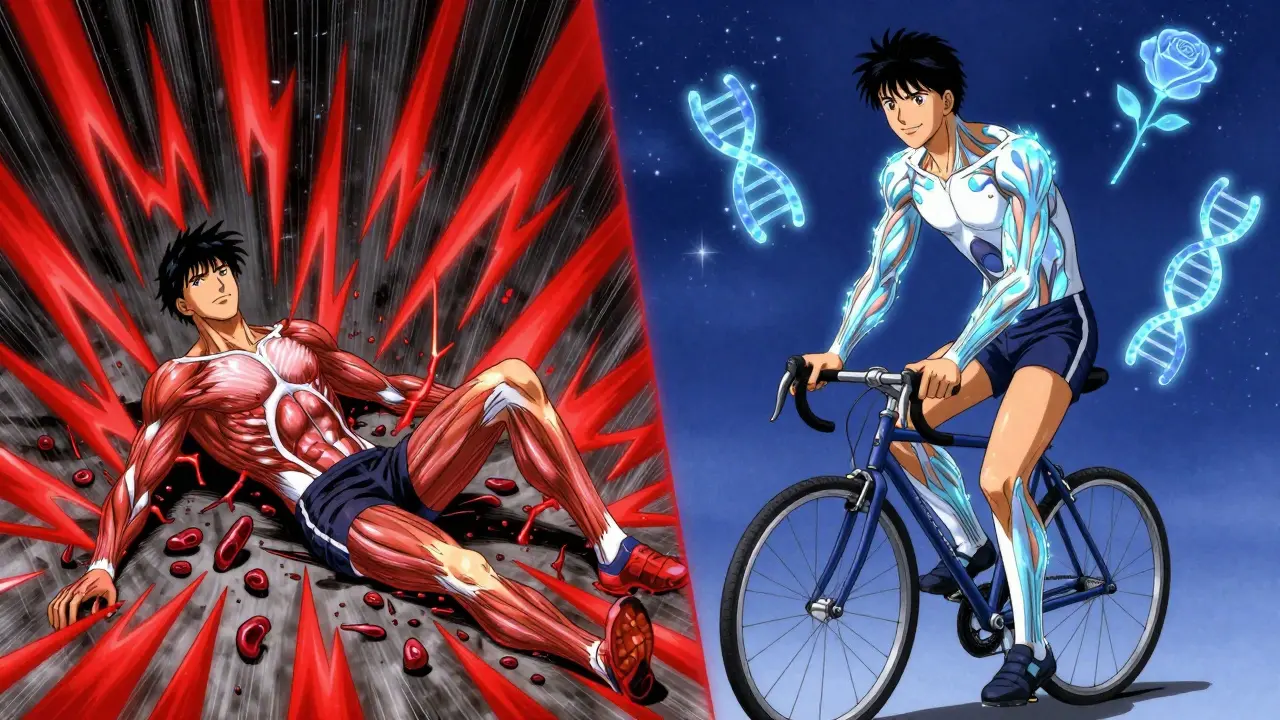
Exercise is one of the best things you can do for your heart - even if you’re on statins. The American Heart Association recommends 150 minutes a week of moderate activity. But here’s the twist: not all exercise is safe for everyone on statins. A major 2023 study from Radboud University Medical Center put 105 people through a 30-minute bike test. They measured muscle damage markers like creatine kinase (CK). The results? No difference between statin users (with or without pain) and people not taking statins. Moderate exercise didn’t spike muscle damage. But then there’s the other side. A 2007 study of Boston Marathon runners showed statin users had nearly 50% higher CK levels after the race. One runner had CK levels over 12,000 U/L - more than 60 times the normal range. That’s rhabdomyolysis, a dangerous breakdown of muscle tissue that can damage kidneys. The key difference? Intensity. Moderate exercise - walking, cycling at a steady pace, swimming - is safe. Vigorous exercise - HIIT, heavy lifting, downhill running, long-distance races - raises the risk.What Type of Exercise Is Safe?
Here’s what the latest guidelines say:- Safe: Brisk walking, light cycling, swimming, elliptical training, yoga, tai chi. Aim for 40-70% of your max heart rate.
- Use caution: Strength training with heavy weights, high-rep circuits, long hikes with steep climbs. These involve eccentric muscle contractions - when muscles lengthen under tension - which cause more damage in statin users.
- Avoid for now: HIIT, CrossFit, sprinting, competitive sports, or anything that pushes you to exhaustion. One 2016 study showed statin users had 300% more CK rise after eccentric exercise than non-statin users.

Why Some People Handle It Better Than Others
Not everyone on statins gets muscle pain. Why? First, pre-existing fitness matters. People who exercised regularly before starting statins are 37% less likely to develop muscle pain, according to Harvard Health. Your muscles are already adapted to stress. Second, genetics. A gene variant called SLCO1B1 makes some people far more likely to get muscle symptoms. If you carry it, your body clears statins slower, letting them build up in muscles. Testing for this gene is still rare - but that’s changing. By 2026, doctors may routinely screen for it before prescribing statins. Third, statin dose and type. High-dose atorvastatin (80 mg) increases myopathy risk 10.5 times more than pravastatin (40 mg), according to FDA data. Lower doses and hydrophilic statins are safer.What to Do If You Have Muscle Pain
Don’t quit exercise. Don’t quit your statin. But do this:- Track your pain. Is it constant? Then it’s likely statin-related. Does it show up only after workouts? Then it’s exercise-induced. Statin pain lingers. Exercise pain fades in a day or two.
- Scale back intensity. Swap HIIT for brisk walking. Swap heavy squats for bodyweight lunges. Focus on consistency, not intensity.
- Try a statin switch. Talk to your doctor about switching to rosuvastatin or pravastatin. Studies show 65% of people feel better after the switch.
- Consider CoQ10. A 2023 meta-analysis found 200 mg daily of CoQ10 reduced muscle pain in 75% of statin users. It’s not a cure, but it helps.
- Monitor CK levels. If you’re planning to increase activity, ask your doctor for a baseline CK test. If levels hit 1,000 U/L or higher after exercise, pause and reassess.
Cam Jane
January 4, 2026 AT 17:48Okay real talk-I was on atorvastatin and thought my leg cramps were just aging. Turned out it was the statin. Switched to rosuvastatin and started walking 45 mins daily. No more pain. CoQ10 helped too. Don’t quit movement. Just tweak the script.
My doctor was like ‘it’s all in your head’ until I showed him the CK numbers. Now he actually listens. You got this.
Mukesh Pareek
January 4, 2026 AT 22:24From a clinical pharmacology standpoint, the lipophilicity of statins directly correlates with myotoxicity due to enhanced mitochondrial membrane penetration and subsequent ROS generation. Hydrophilic agents like rosuvastatin exhibit lower tissue affinity, thereby reducing myocyte exposure. Additionally, SLCO1B1 polymorphisms significantly alter hepatic uptake kinetics-genotyping is not optional in high-risk cohorts.
Matt Beck
January 6, 2026 AT 16:51So… we’re just supposed to ‘listen to our bodies’? 😅 Like our bodies aren’t already screaming at us through pain, fatigue, and existential dread? I mean, I get it-move, but don’t move too hard… unless you’re doing the 4Days March, then it’s fine? 🤔
Also-CoQ10? Is that like the new kale? I’m just here for the miracle supplement that fixes everything we broke with Big Pharma.
Beth Templeton
January 7, 2026 AT 01:54So… walking is safe but squats aren’t? Interesting. So if I do 100 squats slowly, is that ‘eccentric’ or just ‘bad luck’? 😏
Kelly Beck
January 8, 2026 AT 10:54YOU CAN DO THIS. Seriously. I was scared too. Started with 10-minute walks, then 20, then 30. Didn’t lift a single dumbbell for 6 months. Switched to pravastatin. Took 100mg CoQ10. Now I hike on weekends and feel stronger than I did in my 20s.
It’s not about being perfect. It’s about showing up. Even if it’s just to the porch. Even if it’s just to breathe. Your heart remembers every step.
And if you’re tired? Rest. You’re not failing. You’re healing.
Susan Arlene
January 9, 2026 AT 15:19statins be wild huh
i took them for a month and my legs felt like wet paper towels
switched to ezetimibe and now i can climb stairs without crying
also coq10 tastes like chalk but i mix it in peanut butter so its fine
why does medicine have to be so confusing
Dana Termini
January 10, 2026 AT 10:14The science here is solid. I’ve seen patients go from terrified of movement to thriving on moderate activity after switching statins. It’s not about fear-it’s about precision. The body adapts when we give it the right signals. This post gives people the tools to do that without sacrificing heart health.
Indra Triawan
January 11, 2026 AT 09:32They say exercise helps… but what if your body is just… broken? What if the statin didn’t just cause pain-it stole your trust in your own skin? I used to run marathons. Now I cry when my knees creak. Is it the drug? The years? The silence from doctors?
I don’t know anymore. I just know I miss my body.
Melanie Clark
January 11, 2026 AT 11:35Have you considered that this entire narrative is a pharmaceutical industry ploy to keep you dependent on drugs and supplements? CoQ10 is sold by the same companies that make statins. The ‘safe exercise’ guidelines? Written by cardiologists with ties to big pharma. The 4Days March study? Funded by a Dutch bank that owns shares in AstraZeneca.
What if the real solution is… not taking anything at all?
Vinayak Naik
January 12, 2026 AT 10:15yo i was on simvastatin 40mg and my quads felt like they were made of old tires
switched to rosuvastatin 10mg + coq10 200mg + daily walks
now i can squat my nephew without whimpering
also-side note-indian guys on statins? we gotta watch it. our genes + curry + chai = extra spicy muscle drama
talk to your doc. dont be a hero
Venkataramanan Viswanathan
January 13, 2026 AT 23:49In India, we have a saying: ‘Jab ghar ka darr, tab ghar ka bhar.’ When the fear is at home, the strength must also come from home. Statins are not the enemy. Ignorance is. Knowledge is your exercise. Your doctor is your coach. Your body? Your temple. Treat it gently, but don’t abandon it.
And yes-CoQ10 helps. But so does chai with ginger. Sometimes, the simplest things hold the deepest medicine.