

Diphenhydramine Overdose Risk Calculator
Dose Safety Assessment
Enter your weight and diphenhydramine dosage to check if it's within safe limits
What Happens When You Take Too Much Diphenhydramine?
Diphenhydramine is in almost every medicine cabinet. You’ve probably seen it on the shelf as Benadryl, Sominex, or Tylenol PM. It’s cheap, easy to get, and feels harmless-until it isn’t. Taking more than the recommended dose-especially 5 mg per kilogram of body weight or more-can turn a sleepy-time pill into a medical emergency. At doses above 20 mg/kg, it can shut down your heart, trigger seizures, or send your body into hyperthermic meltdown. This isn’t theoretical. Every year in the U.S., poison control centers handle 12,000 to 15,000 cases of diphenhydramine overdose. And it’s getting worse.
The Anticholinergic Toxidrome: What Your Body Does When It’s Overloaded
When diphenhydramine floods your system, it doesn’t just make you drowsy. It blocks acetylcholine, a key neurotransmitter that controls everything from your heart rate to your ability to sweat. The result? A cluster of symptoms known as the anticholinergic toxidrome. Think of it as a checklist of danger signs:
- Dry as a bone: Your mouth feels like cotton. Your skin is hot and dry because you can’t sweat.
- Red as a beet: Your face and chest flush bright red from blood vessel dilation.
- Blind as a bat: Your pupils are wide, fixed, and unresponsive. You can’t focus on anything.
- Mad as a hatter: You’re confused, hallucinating, or screaming at things that aren’t there. Some people think they’re being chased or that their skin is crawling.
- Hot as hades: Body temperature soars past 104°F. This isn’t a fever-it’s your brain losing control of heat regulation.
- Full as a flask: Your bladder swells. You can’t pee, even though you desperately need to.
These aren’t side effects. They’re warning signs your nervous system is being hijacked.
When It Gets Life-Threatening: Cardiac and Neurological Collapse
Mild cases might just make you groggy. But when someone takes 300 mg, 500 mg, or even 600 mg-common in social media challenges-the real danger kicks in. About 15-20% of severe overdoses lead to seizures. That’s not just convulsions. It’s brain activity gone wild, often followed by coma.
The heart is the silent killer here. Diphenhydramine blocks sodium channels in heart muscle, just like tricyclic antidepressants. That’s why an EKG becomes critical. A QRS complex longer than 100 milliseconds means your heart’s electrical signal is slowing dangerously. QTc prolongation beyond 500 ms puts you at risk for torsades de pointes-a deadly arrhythmia that can turn into cardiac arrest.
Some patients develop rhabdomyolysis: muscles break down so badly that they flood the kidneys with toxic proteins. Creatine phosphokinase levels can spike above 10,000 U/L. Without dialysis, acute kidney failure follows.
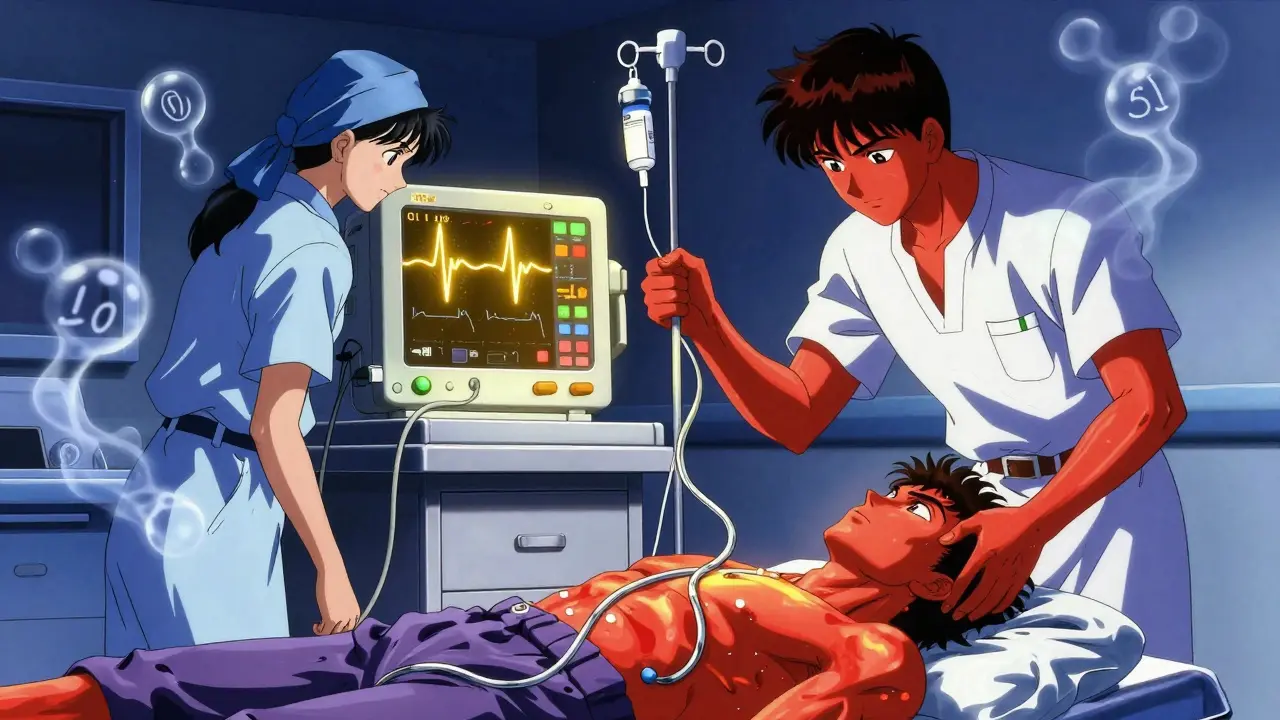
What Emergency Teams Do When You Show Up
If someone collapses after swallowing a bottle of Benadryl, the ER team doesn’t wait. They go straight to ABCDE: Airway, Breathing, Circulation, Disability, Exposure. They check your vitals fast-heart rate, blood pressure, temperature, oxygen levels. Then they grab an EKG. If the QRS is widened or the QTc is long, they act immediately.
Here’s what happens next:
- Seizures or severe agitation? They give diazepam or lorazepam. Benzodiazepines calm the brain faster than anything else.
- QRS over 100 ms? They start sodium bicarbonate. This isn’t baking soda. It’s an IV drip that forces sodium back into heart cells, correcting the electrical block.
- QTc over 500 ms? Magnesium sulfate is given to stabilize the heart rhythm.
- Delirium, hallucinations, confusion? They may give physostigmine. Yes, it sounds scary-it reverses the anticholinergic effects-but it’s safe when used correctly. Studies show 87% of patients improve with physostigmine, compared to just 24% with sedatives alone.
- Can’t urinate? A catheter goes in. Bladder distension is common in 35-40% of cases.
- Body temperature above 102.2°F? Ice packs, cooling blankets, fans. They treat the heat like a burn.
And no-they don’t rely on blood tests for diphenhydramine levels. Those don’t help. The symptoms guide treatment, not the numbers.
The Rise of the Benadryl Challenge
Why are overdoses rising? Social media. Between 2018 and 2022, intentional overdoses among teens jumped 300%. TikTok, Reddit, and YouTube are full of videos where people boast about taking 10, 20, even 30 pills to get high. One Reddit user wrote: "Took 600 mg thinking I could get high. Woke up in the ER with a catheter and IV." That’s not a joke. That’s a real person who almost died.
The FDA warned about this in 2021. The American Academy of Pediatrics launched "Don’t Take the Benadryl Challenge" campaigns. But the videos keep coming. And kids aren’t always aware they’re mixing it with acetaminophen in Tylenol PM. That’s a double threat-liver damage on top of heart failure.
What You Should Do Right Now
If you suspect someone overdosed on diphenhydramine:
- Call 911 immediately. Don’t wait for symptoms to get worse.
- Call Poison Control at 1-800-222-1222. They’ll walk you through what to do while help is coming.
- Don’t try to make them vomit. That can cause more harm.
- Bring the bottle or packaging to the hospital. It helps doctors know exactly what was taken.
Even if they seem okay after 30 minutes, don’t assume they’re safe. Cardiac problems can show up 2 to 4 hours later. Observation for at least 6 hours is standard. If they had any heart changes, they may need 24-hour monitoring.

Recovery Isn’t Instant
People who survive often don’t feel normal for days. Sixty-five percent report lingering drowsiness for 24 to 48 hours. Forty percent say they’re still confused, foggy, or disoriented. Some have trouble remembering what happened. Urinary retention can last long after the overdose, requiring catheterization for hours or even days.
And the psychological toll? Many who survive the physical effects say the hallucinations were terrifying. They describe feeling trapped in their own body, unable to speak or move, while seeing monsters or hearing voices. That trauma doesn’t vanish with the last IV drip.
What’s Changing in Treatment
For years, doctors were afraid to use physostigmine. They thought it could trigger seizures or heart problems. But new data from a 2023 multicenter study in Clinical Toxicology shows it’s safer than we thought. Adverse events? Only 4.7%. No deaths were linked to the drug itself. Now, experts are pushing to use it earlier-not as a last resort, but as a first-line option for severe delirium.
Also, new smartphone apps like Poison Help are making it easier to get real-time advice. Over 150,000 people have downloaded it since 2021. That’s a lifeline for parents, teens, or anyone who panics after a pill mix-up.
Bottom Line: Don’t Underestimate This Pill
Diphenhydramine isn’t just a sleepy-time remedy. It’s a powerful drug with a narrow safety margin. What feels like a harmless way to get high can quickly become a death sentence. The same chemical that helps you sleep can stop your heart. The same tablet that relieves allergies can send you into a psychotic break.
If you or someone you know is using it recreationally, stop. If you’re worried about a loved one’s use, talk to them now. And if you ever suspect an overdose-call for help. Every minute counts.
Can you die from a diphenhydramine overdose?
Yes. While fatal outcomes are rare-estimated at about 0.5% in severe cases-they do happen. Deaths occur when overdose leads to cardiac arrest, prolonged seizures, or extreme hyperthermia that damages organs. Doses above 20 mg/kg carry the highest risk, especially in children and teens.
Is Benadryl safe if you take too many at once?
No. The recommended adult dose is 25-50 mg every 4-6 hours. Taking more than 100 mg at once puts you at risk for toxicity. Doses over 300 mg can be life-threatening. Even if you feel fine at first, dangerous heart and brain effects can appear hours later.
Why does diphenhydramine cause heart problems?
Diphenhydramine blocks sodium channels in heart cells, similar to tricyclic antidepressants. This slows the heart’s electrical signals, leading to QRS widening on an EKG. If the QRS exceeds 100 milliseconds, it increases the risk of dangerous arrhythmias like ventricular tachycardia or torsades de pointes.
Can physostigmine be used safely for diphenhydramine overdose?
Yes, when used correctly. Physostigmine reverses the brain effects of anticholinergic toxicity-confusion, hallucinations, delirium-faster than sedatives. Studies show 87% of patients improve with it. It’s safe for most people, but it’s avoided if the patient has seizures or severe heart block. Always administered in a hospital under supervision.
How long does it take to recover from a diphenhydramine overdose?
Symptoms usually start improving within 6-12 hours after treatment begins. But full recovery can take days. Many people feel groggy or confused for 24-48 hours. Some report lingering memory issues or trouble concentrating for up to a week. Urinary retention and muscle weakness may also last longer than expected.
Are children at higher risk for diphenhydramine overdose?
Yes. Children under 6 are at risk from accidental ingestion-often because they mistake it for candy. Teens are at risk from intentional misuse, especially due to social media challenges. In 2022, 68% of all diphenhydramine overdoses occurred in people under 20. Their smaller bodies process the drug differently, making toxicity more likely at lower doses.
Anu radha
December 16, 2025 AT 20:40This post saved my cousin’s life. She took 10 pills thinking it’d help her sleep, woke up screaming at walls. We called 911 right away. She’s okay now, but I’ll never let my kids near Benadryl without supervision.
Jody Patrick
December 17, 2025 AT 01:19My grandma used to give me Benadryl for allergies. Never knew it could kill you. Thanks for laying it out so clear. Sharing this with my whole family.
Martin Spedding
December 18, 2025 AT 14:34LOL teens think they’re edgy taking 600mg. Bro, you’re not a meme, you’re a statistic waiting to happen. #DontBeAnIdiot
Brooks Beveridge
December 18, 2025 AT 18:53Man, I used to think this stuff was harmless. I took 300mg once in college ‘cause I was bored. Woke up three hours later in a hospital bed with a catheter and my mom crying. I didn’t hallucinate, but I felt like my brain was wrapped in wet cardboard. No one warned me. No one talks about this. This post? It’s the kind of thing that should be mandatory in high school health class. Not just for kids - for parents, teachers, coaches. We act like it’s just a sleepy pill like Tylenol, but it’s basically a chemical grenade with a candy coating. And the worst part? It’s not even fun. It’s terrifying. You’re conscious but trapped. You can’t move, can’t scream, and your mind is screaming back at you. I still get flashbacks. If you’re reading this and you’ve ever thought about trying it - don’t. Just don’t. There’s no high worth waking up in a hospital with your bladder full and your heart barely ticking. I’m not trying to scare you. I’m just saying - I lived. And I wish someone had told me this before I almost didn’t.
Nishant Desae
December 19, 2025 AT 04:35So many people don’t realize that the same chemical that helps with allergies is also a potent neurotoxin at higher doses - it’s like mixing caffeine and cocaine but with way worse side effects. The anticholinergic toxidrome isn’t just some medical jargon, it’s your body screaming for help. And the fact that physostigmine works so well? That’s huge. Doctors used to be scared to use it, but now we know it’s safe if you know what you’re doing. And yeah, the TikTok challenges? They’re not just dumb, they’re deadly. I’ve seen teens come in with QRS complexes wider than a highway - that’s not a joke, that’s cardiac arrest waiting to happen. And parents? They think ‘it’s just Benadryl’ - but if your kid’s pupils are dilated like a cat’s and they’re talking to invisible people, that’s not a phase, that’s a medical emergency. Please, if you’re reading this, talk to your kids. Not like a cop, not like a lecture - like someone who cares. Because this isn’t about rebellion, it’s about survival.
Erik J
December 19, 2025 AT 15:33Interesting that they don’t rely on blood levels. Makes sense - symptoms are more immediate than lab results. But I wonder if there’s a threshold where physostigmine becomes less effective. Has anyone studied that?
Sachin Bhorde
December 19, 2025 AT 18:18Yo, physostigmine is a game changer but u gotta be carefull with it - if the patient has seizures or cardiac block, it can backfire. But for pure anticholinergic delirium? 87% improvement? That’s wild. I work in ER in Mumbai and we’re starting to use it more now. No more just sedating people and hoping they wake up. We’re actually fixing the root cause. Also - Tylenol PM = double whammy. Liver + heart. Don’t mix. Ever.
Jane Wei
December 19, 2025 AT 23:46My roommate tried the challenge last year. Woke up in the hospital with a catheter. He said the worst part wasn’t the heat or the racing heart - it was the feeling that his skin was crawling with ants and he couldn’t move a muscle. He still doesn’t talk about it. I just made sure he never touches that stuff again.
Raven C
December 20, 2025 AT 15:50It is, indeed, profoundly disconcerting to observe the casual, almost flippant, normalization of pharmacological self-harm among adolescents - a phenomenon that, one might argue, is emblematic of a broader cultural erosion of rationality and self-preservation. The fact that such a potent anticholinergic agent is freely available over-the-counter - and worse, actively glamorized on social media - speaks volumes about the alarming degradation of public health literacy. One is left to wonder: where are the guardians? The educators? The moral compasses?
Jody Patrick
December 20, 2025 AT 23:22My 14-year-old niece saw a TikTok about Benadryl. I sat her down and showed her this post. She said, ‘I thought it was just for sleep.’ Now she tells her friends not to try it. Small wins.